
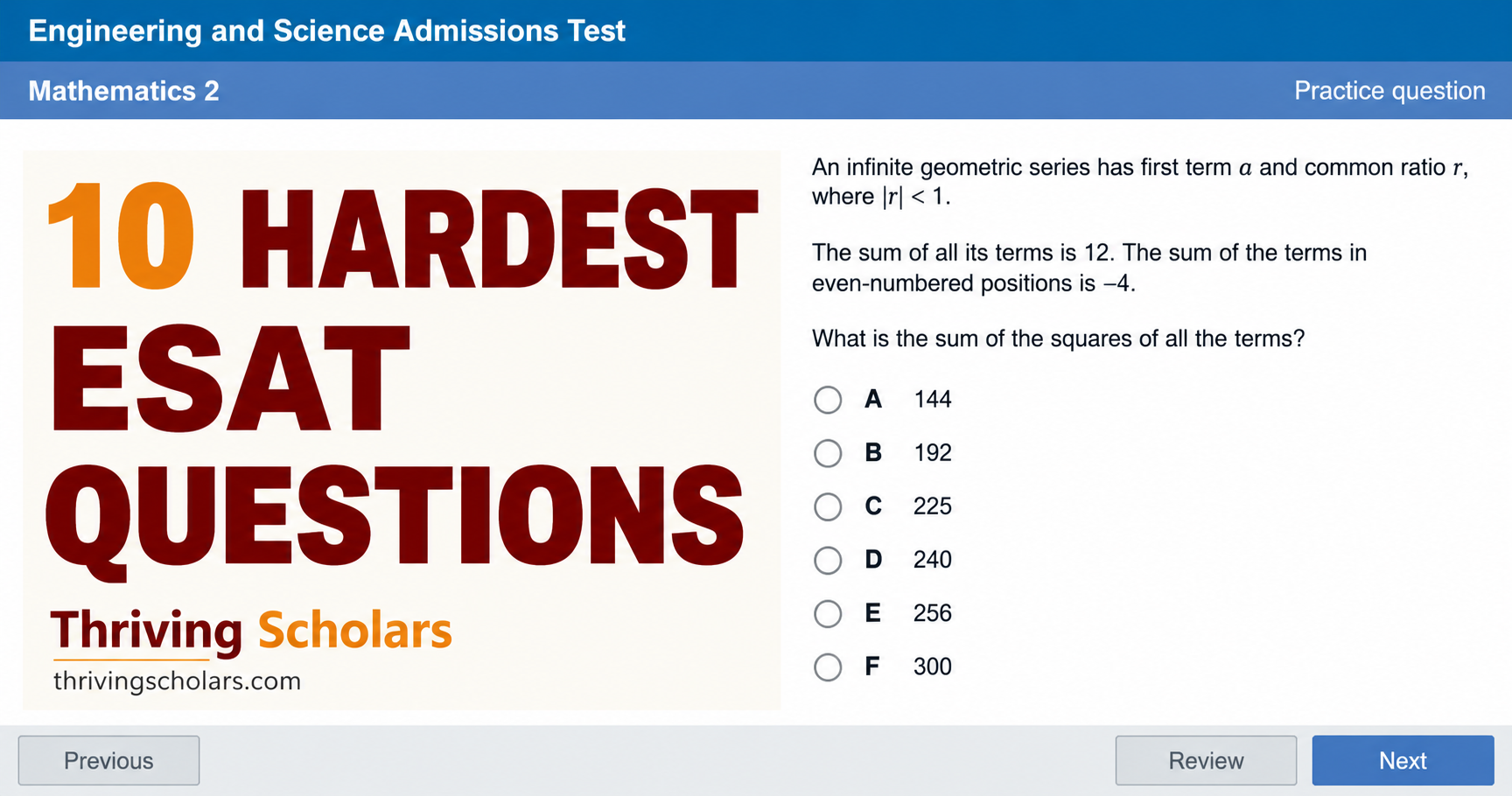
The hardest questions often start with familiar ideas. The challenge is spotting which ones to connect—and which tempting shortcut will fail.
These ten original problems build on ideas from published ENGAA and NSAA papers, adding a further reasoning step while staying within the ESAT specification. Choose your subjects, try each question, then check the reasoning underneath.
10 original questions · 5 modules · No calculator. Two questions per module. This is a stretch set, not a full mock or a prediction of your score. The questions are newly written; they are not official ESAT questions or recalled test content.
How to use this ESAT challenge
Choose the modules you are preparing for. Work through each problem without a calculator, select an answer and check it. Open the worked solution whenever you are ready; each one includes the key idea, a common trap and its past-paper starting point.
For a broader revision plan, see our ESAT preparation guide. Use the free TMUA and ESAT maths practice bank to mix these stretch problems with regular past-paper practice.
Try the 10 hardest ESAT practice questions
Showing all 10 questions.
One area, two possible lengths
A square has side length . Point lies on , point lies on , and is the midpoint of .
Given that , with , the area of triangle is .
What is the positive difference between the two possible values of ?
Show solutionHide solution for question 1
Answer B ·
Key idea Find the triangle by subtracting the surrounding regions from the square.
The three regions outside are trapezium , triangle , and triangle . Their areas are
Subtract these from the square’s area:
Set this equal to the given area:
The quadratic formula gives
Both values lie between 0 and 4. Their positive difference is .
Common trap Discarding the second root without checking whether it also gives a valid position inside the square.
Conceptual starting point: ENGAA 2023, Section 1, Q5. ESAT scope: M4.16; M5.14.
What did the transfer contain?
Bag X contains 2 red counters and 3 blue counters. Bag Y contains 1 red counter and 2 blue counters. Apart from colour, all counters are identical.
Two counters are selected at random from X, without replacement, and transferred to Y. Two counters are then selected at random from Y, without replacement.
The two counters selected from Y are the same colour.
Given this information, what is the probability that both counters transferred from X were red?
Show solutionHide solution for question 2
Answer C ·
Key idea Weight each possible transfer by how likely it is to produce the observed result.
Let be the number of red counters transferred. There are ten equally likely unordered pairs in X. One pair is red–red, six are mixed, and three are blue–blue.
Possible transfers and their consequences Transfer probability Y after transfer Probability of a same-colour pair from Y 0 1 red, 4 blue 1 2 red, 3 blue 2 3 red, 2 blue So the probability of the observed same-colour pair is
The probability of transferring two reds and then observing a same-colour pair is . Restricting to the observed outcomes gives
Common trap Using the original 1/10 probability after being given information about the second draw.
Conceptual starting point: NSAA 2023, Section 1, Q20. ESAT scope: M7.5–M7.7.
A series hidden inside a series
An infinite geometric series has real first term and common ratio , where .
The sum of all its terms is 12. The sum of the terms in the even-numbered positions is ; that is,
What is the sum of the squares of all the terms of the original series?
Show solutionHide solution for question 3
Answer D ·
Key idea The even-position terms form a geometric series with ratio r².
The two given sums are
Divide the second equation by the first:
Hence , so and
The squared terms have first term and ratio :
Common trap Squaring the total sum. The square of a sum includes cross-products; it is not the sum of the squares.
Conceptual starting point: ENGAA 2023, Section 1, Q25. ESAT scope: MM2.3.
Find the contact point before the area
The curve has equation
The tangent to at the point with -coordinate , where , meets the curve again at a different point with -coordinate .
The positive difference between and is 3.
What is the area of the finite region bounded by the tangent and the curve?
Show solutionHide solution for question 4
Answer E ·
Key idea Subtract the tangent from the cubic, then use its factorisation to locate the second intersection.
Write . Since , the tangent is
Subtracting this line from the curve and factorising gives
The second intersection is therefore . As , we have , so
Thus , , and the tangent is .
Between these intersections, the curve lies above the tangent because
The required area is
Common trap Integrating the cubic alone instead of the difference between the curve and the tangent.
Conceptual starting point: ENGAA 2023, Section 1, Q31 and Q33. ESAT scope: MM1.6; MM6.2–MM6.3; MM7.1–MM7.2.
The switched resistor network
An ideal battery with constant voltage is connected to the resistor network shown. Resistor A has resistance , B has resistance , and C and D each have resistance .
A is in series with two parallel branches: B alone, and C followed by D. Switch S is connected across D only. Wires and the closed switch have negligible resistance.
With S open, the power dissipated in A is . The switch is then closed.
What is the new power dissipated in B?
Show solutionHide solution for question 5
Answer B ·
Key idea The battery voltage stays fixed; the voltage across the parallel branches does not.
Let the battery voltage be . With S open, the parallel branches each have resistance . Their combined resistance is , giving total resistance .
Therefore A has voltage , so
Hence .
Closing S bypasses D. The parallel branches are now and , with combined resistance . The total resistance is .
The voltage across B is the voltage across this parallel combination:
Using for resistor B gives
You can obtain a parallel resistance from the current rules: at voltage , branches and draw total current , equivalent to resistance .
Common trap Applying the rise in total circuit current to B. The current through A and the current through B are different.
Conceptual starting point: ENGAA 2023, Section 1, Q4 and Q28. ESAT scope: P1.2f, i–m.
A collision before the springs
A cart moves at and collides with a stationary cart. They stick together.
After the collision, the joined carts compress two massless ideal springs connected end-to-end against a fixed wall. The spring constants are and .
Both springs are initially uncompressed and remain within their linear elastic ranges. Motion is along one horizontal line. Friction and all energy losses after the collision are negligible.
What is the maximum compression of the spring?
Show solutionHide solution for question 6
Answer C ·
Key idea Conserve momentum during the collision, then conserve energy during compression.
Momentum conservation gives the speed just after the collision:
The kinetic energy available to compress the springs is
Let the softer spring’s compression be . The force is the same through both massless springs, so the stiffer spring compresses by .
At maximum compression, all the joined carts’ kinetic energy is stored in the springs:
Taking the positive root gives .
Common trap Conserving kinetic energy through the sticking collision, or reporting the total compression of both springs.
Conceptual starting point: ENGAA 2023, Section 1, Q40. ESAT scope: P3.3c–d; P3.6a–b; P3.7d, f.
Find the material that did not react
A solid mixture contains sodium carbonate, , sodium hydrogencarbonate, , and an inert impurity that does not react with acid.
The mixture reacts completely with of hydrochloric acid. All the carbon dioxide produced is collected: its dry volume is at room temperature and pressure.
The acid remaining afterwards requires exactly of sodium hydroxide for complete neutralisation.
Use a molar gas volume of , and molar masses of for and for .
What percentage of the original mixture’s mass is inert impurity?
Show solutionHide solution for question 7
Answer F ·
Key idea The gas measures the total moles of the two salts; the acid measures a differently weighted total.
Initial HCl is . The remaining HCl is , because HCl and NaOH react 1:1.
So the salts consumed of HCl.
Let and be the moles of carbonate and hydrogencarbonate respectively. Each gives one mole of carbon dioxide per mole of salt. Therefore
Carbonate consumes two moles of HCl per mole, while hydrogencarbonate consumes one:
Subtracting gives , hence . The mass of the two salts is
The impurity has mass . Its percentage is
Common trap Treating all the acid added as acid consumed, or assigning the same acid-to-salt ratio to both salts.
Conceptual starting point: NSAA 2023, Section 1, Q51 and Q54. ESAT scope: C4.3, C4.6, C4.8–C4.10; C9.1b, f.
Oxygen comes from two places
A saturated alcohol has molecular formula , where is a positive integer.
A sample is completely used up in an incomplete-combustion reaction, consuming of oxygen at room temperature and pressure.
The only products are carbon dioxide, carbon monoxide and water. The mole ratio is .
Use , , , and a molar gas volume of .
What is the alcohol’s molecular formula?
Show solutionHide solution for question 8
Answer B ·
Key idea Count all oxygen atoms in the products, then subtract the oxygen already present in the alcohol.
For one mole of alcohol, the carbon products are moles of and moles of . The hydrogen produces moles of water.
The products therefore contain this many moles of oxygen atoms:
One mole of oxygen atoms comes from the alcohol itself. The oxygen gas required per mole of alcohol is consequently
The alcohol’s molar mass is . Use the measured oxygen consumption:
This simplifies to , giving .
The molecular formula is .
Common trap Counting every oxygen atom in the products as an atom supplied by oxygen gas.
Conceptual starting point: NSAA 2023, Section 1, Q60. ESAT scope: C3.4; C4.1, C4.3, C4.6, C4.8; C13.1f; C13.5a.
What do two purple offspring tell you?
In a plant species, purple flowers are determined by a dominant allele ; white flowers occur only in plants with genotype .
Two heterozygous plants are crossed. One purple-flowered offspring is selected at random and self-pollinated.
The first two offspring of this selected plant both have purple flowers.
Assume ordinary Mendelian inheritance, no mutations or differences in survival, and independent fertilisations for a fixed parental genotype.
Given all this information, what is the probability that the selected plant’s next offspring has white flowers?
Show solutionHide solution for question 9
Answer D ·
Key idea The observed offspring change how likely the selected parent is to be heterozygous.
The original cross is . Among its purple offspring, the proportions are
If the selected parent is , both first offspring must be purple. If it is , the probability that both are purple is .
The two routes to the observed result therefore have weights
Restricting to those routes, the probability that the selected parent is is .
Only an parent can produce a white offspring by self-pollination; its probability of doing so is . Hence
Common trap Saying each new fertilisation makes the earlier evidence irrelevant. Fertilisations are independent for a known genotype; here the genotype is uncertain.
Conceptual starting point: NSAA 2023, Section 1, Q68. ESAT scope: B4.2–B4.3; M7.7.
From bubble movement to water loss
Two watertight bubble potometers, X and Y, measure water uptake by two leafy shoots. The capillaries have uniform circular cross-sections. Measurements are:
| Measurement | X | Y |
|---|---|---|
| Internal capillary diameter | ||
| Distance moved by bubble | ||
| Time taken | ||
| Total leaf area | ||
| Fraction of water uptake retained by shoot |
During each measurement, the rest of the water taken up is lost by transpiration. There are no other water gains or losses.
What is the ratio of Y’s transpiration rate per unit leaf area to X’s?
Show solutionHide solution for question 10
Answer A ·
Key idea Convert distance to volume, divide by time and leaf area, then account for retained water.
Water uptake is the volume swept by the bubble: . Therefore the ratio of uptake rates per unit leaf area is
Only 80% of Y’s uptake and 90% of X’s uptake are transpired. The required ratio is therefore
A potometer measures water uptake. This question supplies the retained fractions so that actual water loss can be calculated.
Common trap Using capillary diameter instead of cross-sectional area, or treating water uptake as exactly equal to transpiration.
Conceptual starting point: NSAA 2023, Section 1, Q65. ESAT scope: B11.2c–e; M1.1; M3.5; M5.15.
Source ideas and syllabus coverage for each question
Q1 · Mathematics 1
Reverses a side-ratio/area problem: the area is fixed and both geometrically valid lengths must be recovered.
Specification: M4.16; M5.14.
Q2 · Mathematics 1
Uses a two-counter transfer and asks for an earlier event conditional on a later observation.
Specification: M7.5–M7.7.
Q3 · Mathematics 2
Infers a negative ratio from a subsequence sum, then builds a third series from squared terms.
Specification: MM2.3.
Q4 · Mathematics 2
ENGAA 2023, Section 1, Q31 and Q33
Combines polynomial differentiation and integration with an unknown point of tangency and a second intersection.
Specification: MM1.6; MM6.2–MM6.3; MM7.1–MM7.2.
Q5 · Physics
ENGAA 2023, Section 1, Q4 and Q28
Combines switching with a power measurement in a different resistor; the branch voltage must be recalculated.
Specification: P1.2f, i–m.
Q6 · Physics
Adds a preceding inelastic collision and asks for one spring’s compression rather than the combined extension.
Specification: P3.3c–d; P3.6a–b; P3.7d, f.
Q7 · Chemistry
NSAA 2023, Section 1, Q51 and Q54
Combines gas-volume data and a back-titration to separate two reacting components from an inert impurity.
Specification: C4.3, C4.6, C4.8–C4.10; C9.1b, f.
Q8 · Chemistry
Works backwards from mass and oxygen consumption to identify an unknown alcohol, with unequal carbon-product amounts.
Specification: C3.4; C4.1, C4.3, C4.6, C4.8; C13.1f; C13.5a.
Q9 · Biology
Uses offspring observations to update the uncertain genotype of a parent selected by phenotype.
Specification: B4.2–B4.3; M7.7.
Q10 · Biology
Compares different capillaries, times and leaf areas, then distinguishes uptake from transpiration using supplied retention data.
Specification: B11.2c–e; M1.1; M3.5; M5.15.
Make the difficult question useful
After each solution, write down the decision that unlocked it: subtract the surrounding areas, condition on the evidence, change the conservation law, or count atoms before substituting numbers. Then return to the question later and try to make that decision without help.
Keep regular practice mixed. These are deliberately demanding questions; your preparation should also include shorter questions that reward quick, accurate execution.
Sources and specification
This set was checked against UAT-UK’s content specification for the October 2026 and January 2027 sittings. Its archive identifies older questions outside ESAT’s scope; the new problems here use the topics listed in the source and syllabus notes above.
- Official ESAT content specification, 2026/27
- UAT-UK’s ENGAA and NSAA past-paper archive
- ENGAA 2023, Section 1 and NSAA 2023, Section 1
Original questions and solutions © 2026 Thriving Scholars. Source papers belong to Cambridge University Press & Assessment. Thriving Scholars is independent of UAT-UK and Cambridge University Press & Assessment.
Continue with ESAT preparation