Start with your actual contest date
The official AMC 8 competition window is 21–27 January 2027. Your host chooses the date within that window, so confirm the local arrangement before placing the final week in your calendar. Source: MAA’s 2026–27 calendar.
AMC 8 has 25 questions and a standard 40-minute limit. A correct answer earns one point; wrong answers and blanks both earn zero. The US/Canada rules require supervised participation at an approved site; an online practice test at home is preparation, not official registration. Source: current AMC rules.
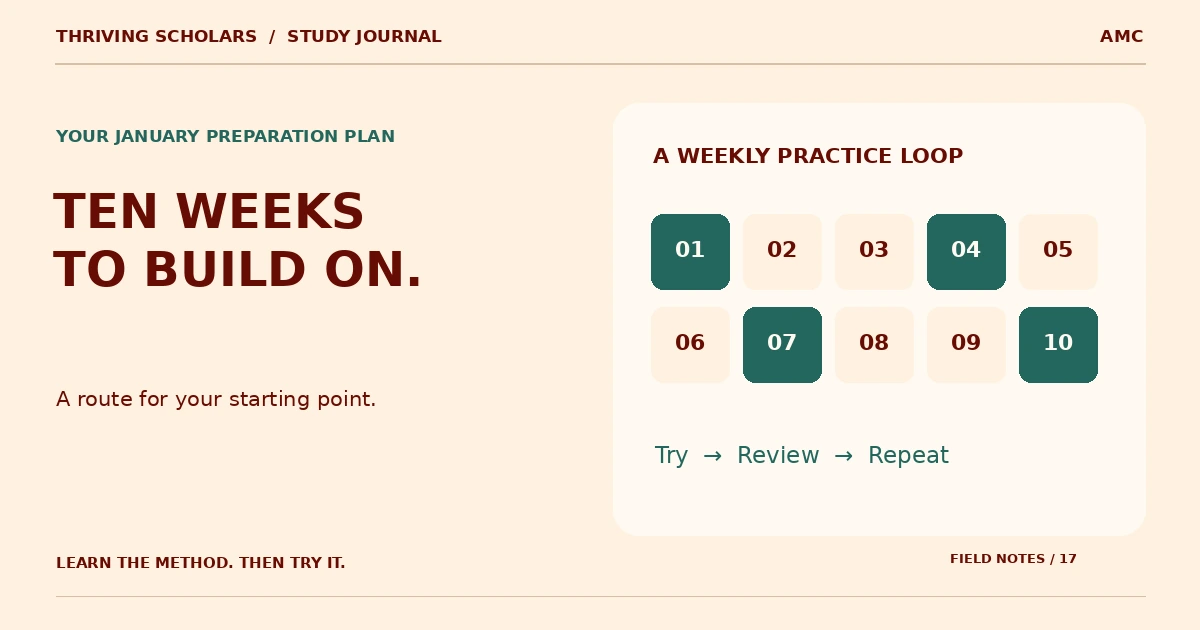
Starting on 15 November leaves 67–73 days until the 21–27 January 2027 window. Align the ten teaching blocks below with your host’s actual contest date, shortening repeated practice when necessary while protecting review and the final rehearsal. This is a suggested ten-week teaching sequence, not an official programme. If you have fewer weeks, combine related topic weeks and retain the diagnostic, error review and final rehearsal. If you have longer, repeat a difficult week using fresh questions. Compressing everything into longer weekend sessions is often less manageable than preserving a few short, focused sessions.
Try six questions before choosing a route
These original questions sample a few starting skills. They are not a full AMC 8 diagnostic and their score does not predict a contest result. Attempt them without a calculator. After each answer, note whether your reasoning was clear, hesitant or dependent on a hint.
A correct answer with an unexplained guess needs a different next step from a correct answer you can justify. Equally, one careless arithmetic error should not persuade you that an entire topic is beyond you. Read the solutions, then redo any uncertain question on a later day.
Choose the route that matches your working
Foundation: choose this if fractions, simple equations or reading a word problem regularly stop you before contest reasoning begins. The early weeks keep time pressure low and make the basic mathematical language reliable.
Developing: choose this if you usually understand the school mathematics but lose marks selecting methods, organising cases or finishing a paper. This route alternates targeted practice with mixed questions so you learn to recognise a method without being told the topic.
Advanced: choose this if accessible questions are reliable and your main obstacles are unfamiliar problems, elegant counting arguments or precision under time pressure. The route deliberately keeps some easier questions: a difficult problem does not make careless errors elsewhere less costly.
The labels describe the work you need now. Move between routes by topic. A student can need foundation work on ratios while taking the advanced geometry tasks.
Your ten-week plan
Use the selector to explore all three routes. Aim for a sustainable rhythm: one session to learn or repair a method, one to practise it, and one to review or mix it with older material. The numbers of practice questions below are suggestions; stop and investigate if you are repeating the same error.
For counting weeks, use the twelve-question counting and probability lesson. For full rehearsal, use a complete level-appropriate paper or AMC practice test, not the six-question orientation above. Follow the timing and format of the test you are actually practising.
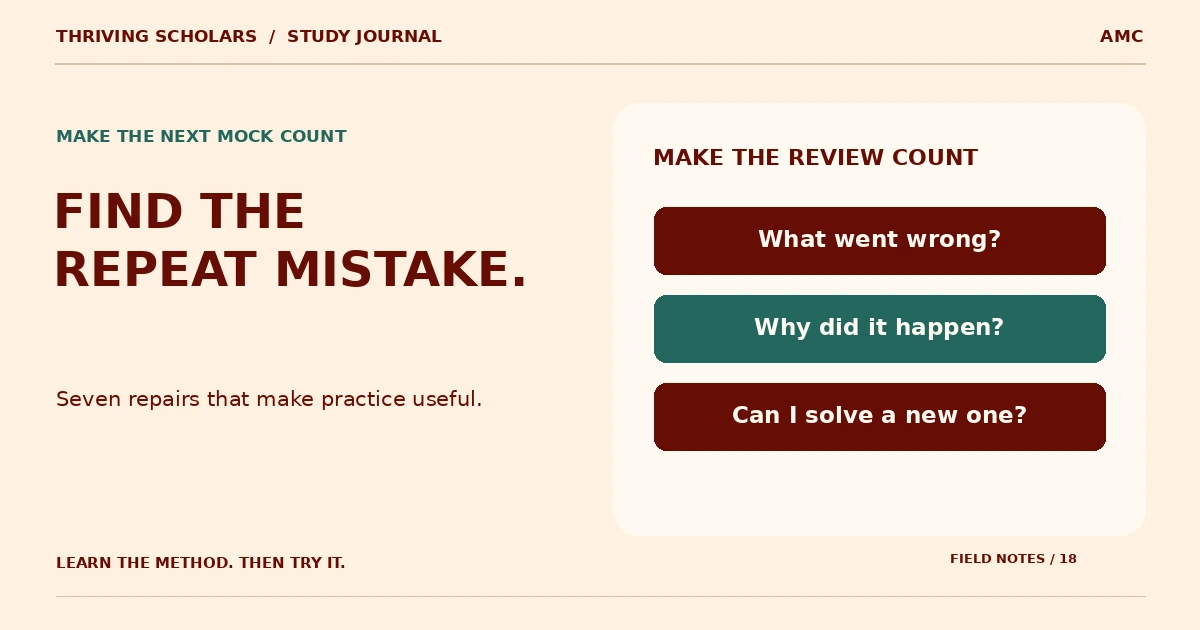
Review a mock in three passes
First, recover your own reasoning. Before opening solutions, work on the questions you left or missed. Use a different pen or a clearly separate page. This distinguishes problems you could solve with more time from problems requiring a new idea.
Next, name the obstacle. A useful error-log entry is specific: “I counted AB and BA separately when the pair was unordered” is more useful than “bad at probability”. Write the original cue, the incorrect move, and the corrected method. If the solution introduces a new fact, add one small example showing why it is true.
Finally, test transfer. Two or three days later, solve a fresh question that uses the same idea. Reproducing a memorised number from the old solution does not demonstrate that you can recognise the method in a new setting.
| Error-log field | Example entry |
|---|---|
| What happened? | I multiplied by 3/5 twice when counters were drawn without replacement. |
| What changed? | After the first draw, both the total number and number of favourable counters changed. |
| What will I notice? | Underline “without replacement” and redraw the remaining bag. |
| How will I check? | Solve a new two-draw problem after a gap and explain both denominators. |
How parents can help—and what to do in the final week
Ask the learner to explain one problem rather than reporting only the score. Useful prompts include “What did you decide to count?”, “Why are those the only cases?” and “Could you test a smaller example?” Allow time for an answer before supplying a method. If a session becomes a long series of hints, step back to a more accessible problem using the same idea.
For timed rehearsal, agree in advance that feedback comes afterwards. During review, praise a precise correction or a well-chosen diagram rather than treating speed as the only success. A family routine works best when its workload is realistic alongside school.
In the final week, verify the host’s instructions, practise with the materials you will use and revisit a compact selection of errors. Since blanks and wrong answers receive the same AMC 8 score, enter an answer for remaining questions before time ends; use any valid elimination you can make. That scoring rule differs from AMC 10/12, where blanks earn credit.
Common questions
Can I prepare for AMC 8 in ten weeks?
How many papers should I do each week?
Do I need to finish every hard question?
Should I guess on AMC 8?
Is the six-question check a full mock or predicted score?
Sources & further reading
Official rules and programme details can change. Use the linked source for your exact course, competition or examination session.
- MAA 2026–27 competition calendarAMC 8 window, 21–27 January 2027.
- MAA current AMC rules and policiesFormat, scoring and official administration requirements.