The most useful shortcut is choosing the right relationship

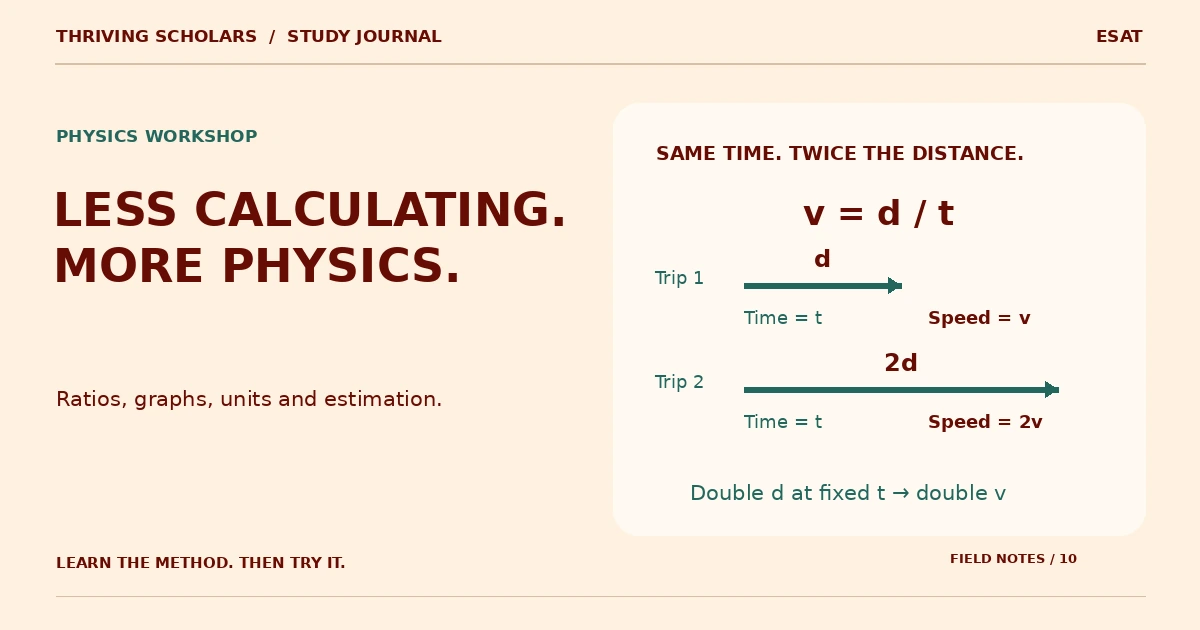
Fast Physics is not a collection of unexplained tricks. It is noticing which quantities change, which remain fixed and which relationship connects them. If a question asks for a ratio, calculating two large absolute values may be unnecessary. If it asks about a conserved quantity, a direct conservation argument can replace several equations.

The ESAT does not allow a calculator. Its Physics preparation material covers mathematical handling as well as physical understanding; see the official subject guide. The questions below are original teaching practice, not official test items or a complete syllabus sample.

Attempt each question before opening its explanation. Then compare the conventional and shorter routes. Keep the shortcut only if you can explain its assumptions. A memorised ratio used in the wrong physical situation is simply a fast way to get the wrong answer.

Four questions to ask before you calculate

Ask yourselfUseful moveCondition to check
Is only a ratio required?Cancel shared constants before substituting values.The supposedly fixed quantities really are unchanged.
Can I use a conservation law?Compare energy or momentum before introducing time or acceleration.Account for external forces and energy transfers.
What do the graph axes mean?Interpret gradient or signed area using units.Distinguish displacement from distance.
What would a plausible answer look like?Check sign, units and whether an increase should raise or lower the result.A reasonableness check supports the calculation; it does not replace it.

For calculations with fractions, delay decimals. For example, (3/2)2/2 is immediately 9/8. Expanding it into several decimal steps makes a simple relationship easier to obscure.

Twelve original questions, with complete worked solutions

Work through the set without a calculator. For each answer, write one line identifying the physical principle before performing arithmetic. After reviewing a solution, try its transfer check: a small change should reveal whether you understood the relationship or simply recognised a pattern.

Try it here

12 no-calculator Physics problems

Original Thriving Scholars teaching questions. Choose an answer, inspect the complete method and try the transfer check.

Question 01 · Scaling and cross-sectional areaFor wires of the same material at the same temperature, resistance is proportional to length divided by cross-sectional area. Wire X has resistance R. Wire Y is 1.5 times as long and has half the diameter of X. What is its resistance?
Need a hint?
Area is proportional to diameter squared.
Worked solution

Answer: 6R. The cross-sectional area becomes (1/2)2 = 1/4 as large. Hence RY/RX = (3/2)/(1/4) = 6.

Conventional route: write both areas as πd2/4 and substitute into the given relationship. Short route: compare scale factors before calculating areas. Halving diameter does not merely halve area.

Transfer check: if Y instead had twice the diameter and the same 1.5 length factor, its resistance would be 3R/8.

Question 02 · Parallel circuits and powerResistors of 6 Ω and 3 Ω are connected in parallel across an ideal 12 V supply. What total electrical power is transferred to the two resistors?
Need a hint?
Each parallel branch has the full supply voltage.
Worked solution

Answer: 72 W. The branch currents are 12/6 = 2 A and 12/3 = 4 A. Their total is 6 A, so P = VI = 12 × 6 = 72 W.

Alternative short route: the equivalent resistance is 2 Ω, giving P = V2/R = 144/2. Adding 6 and 3 treats a parallel circuit as a series circuit.

Transfer check: with the same ideal voltage, removing the 3 Ω branch leaves 24 W in the 6 Ω resistor; the remaining branch voltage is unchanged.

Question 03 · Work and kinetic energyA vehicle is stopped by a constant braking force. In a second trial its mass is unchanged, its initial speed is 50% greater and the braking force is twice as large. Ignore other energy losses. What is the ratio second stopping distance:first stopping distance?
Need a hint?
Braking work equals the initial kinetic energy.
Worked solution

Answer: 9:8. From Fs = mv2/2, stopping distance is proportional to v2/F for fixed mass. The multiplier is (3/2)2/2 = 9/8.

Conventional route: derive the two accelerations and use a constant-acceleration equation. Short route: compare energy and force. Despite the stronger braking, the distance increases because kinetic energy rises by a larger factor.

Transfer check: doubling both the initial speed and braking force doubles the stopping distance.

Question 04 · Energy fractionsA ball is projected vertically upwards with speed u and reaches maximum height H above its launch point. Air resistance is negligible. What is its speed at height 3H/4?
Need a hint?
At the maximum height, all the initial kinetic energy has become gravitational potential energy.
Worked solution

Answer: u/2. At 3H/4, three quarters of the initial kinetic energy has become gravitational potential energy. One quarter remains as kinetic energy. Since kinetic energy is proportional to speed squared, the speed is √(1/4)u = u/2.

Conventional route: find H = u2/(2g), then substitute into v2 = u2 − 2gh. The fraction argument avoids that substitution. Speed is the same at this height on ascent and descent.

Transfer check: at H/2 the speed is u/√2, not u/2.

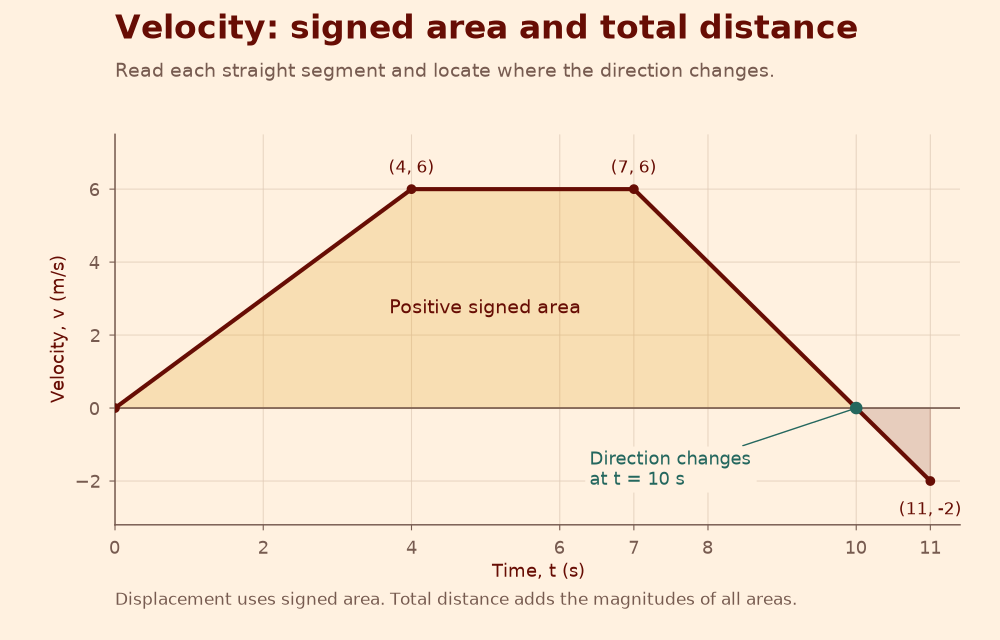
Question 05 · Signed area under a velocity graphA particle moves along a straight line. Its velocity changes linearly from 0 to 6 m/s during 0–4 s, stays at 6 m/s during 4–7 s, and changes linearly from 6 to −2 m/s during 7–11 s. What are its displacement and total distance travelled over the 11 s?
Need a hint?
During the last stage, find when the velocity crosses zero.
Worked solution

Answer: displacement 38 m; distance 40 m. The first triangular area is 4 × 6/2 = 12 m; the rectangle is 3 × 6 = 18 m. In the final stage the velocity falls at 2 m/s each second, crossing zero at 10 s. Its positive triangular area is 3 × 6/2 = 9 m and its negative area is −1 × 2/2 = −1 m.

Displacement is 12 + 18 + 9 − 1 = 38 m. Distance adds magnitudes: 12 + 18 + 9 + 1 = 40 m. The final trapezium shortcut gives net displacement, not distance.

Transfer check: reversing every velocity changes the displacement to −38 m but leaves the distance 40 m.

Question 06 · Pressure and areaTwo pistons in an ideal hydraulic system have areas 4 cm2 and 60 cm2. The pressure increase is transmitted equally through the liquid. A force of 80 N acts on the smaller piston. Ignoring piston weights, friction and height differences, what force can the larger piston exert?
Need a hint?
Equal pressures mean F/surface area is equal for the two pistons.
Worked solution

Answer: 1200 N. The area ratio is 60/4 = 15. Equal pressure gives the same force-per-area ratio, so the larger force is 15 × 80 = 1200 N.

Conventional route: convert both areas to m2, calculate pressure and multiply by the larger area. Short route: matching area units cancel in a ratio. No unit conversion is needed here.

Transfer check: doubling both piston areas leaves the force ratio unchanged; doubling only the larger area doubles its force for the same small-piston force.

Question 07 · Thermal energy and weighted averagesTwo blocks of the same material have masses m and 3m and temperatures 80°C and 20°C respectively. They are brought into thermal contact in an insulated container. Their specific heat capacity is constant and no change of state occurs. What is the final common temperature?
Need a hint?
The larger block has three times the thermal capacity.
Worked solution

Answer: 35°C. Energy lost by the hotter block equals energy gained by the cooler block: mc(80 − T) = 3mc(T − 20). Cancelling mc gives 80 − T = 3T − 60, so 4T = 140 and T = 35°C.

Short route: use the thermal-capacity-weighted mean, (80 + 3 × 20)/4 = 35. The simple average 50°C would apply to equal masses of this same material.

Transfer check: exchanging the two initial temperatures gives (20 + 3 × 80)/4 = 65°C.

Question 08 · Wave speed, period and wavelengthA wave has period 0.25 s and travels at 12 m/s in one region. It crosses into a second region where its speed is 8 m/s, with its frequency unchanged. What is its wavelength in the second region?
Need a hint?
Use wavelength = speed × period.
Worked solution

Answer: 2 m. The frequency remains unchanged, so the period also remains 0.25 s. In the second region, λ = vT = 8 × 0.25 = 2 m.

Conventional route: find f = 1/T = 4 Hz, then use λ = v/f. Short route: multiply speed directly by period. The original 12 m/s is not the speed needed in the final calculation.

Transfer check: the original wavelength is 3 m. The wavelength falls in the same ratio, 2/3, as the speed.

Question 09 · Background-corrected half-lifeA radioactive sample gives a mean detector reading of 188 counts per minute. Twenty minutes later the mean reading is 53 counts per minute. The constant mean background reading is 8 counts per minute. What is the sample’s half-life?
Need a hint?
Subtract the same background from both readings before comparing them.
Worked solution

Answer: 10 minutes. The sample’s net readings are 188 − 8 = 180 and 53 − 8 = 45 counts per minute. The second is one quarter of the first, so two half-lives have passed in twenty minutes. Each half-life is ten minutes.

A direct comparison of 188 and 53 includes counts that are not decaying with the sample. No logarithms are needed once the corrected ratio is recognised.

Transfer check: after ten minutes the expected mean detector reading is 90 + 8 = 98 counts per minute.

Question 10 · Upthrust and densityA uniform block of density 1.2 g/cm3 floats freely in a liquid of density 1.5 g/cm3. Ignore surface-tension effects. What fraction of the block’s volume is below the liquid surface?
Need a hint?
The weight of displaced liquid equals the weight of the floating block.
Worked solution

Answer: 4/5. If the total block volume is V and submerged volume is Vs, equilibrium gives ρliquidVsg = ρblockVg. Thus Vs/V = 1.2/1.5 = 4/5.

Short route: use the density ratio after stating the floating-equilibrium condition. It is the submerged fraction, not the fraction above the surface. A result greater than 1 would be incompatible with free floating for these densities.

Transfer check: in a liquid of density 2.4 g/cm3, half the volume would be submerged.

Question 11 · Parallel springs and elastic energyA Hookean spring extends by 4 cm under an 8 N force. Two identical springs are then connected in parallel and share a total 8 N load equally. What is the total elastic energy stored in the pair?
Need a hint?
Each spring now carries 4 N and extends by 2 cm.
Worked solution

Answer: 0.08 J. Each spring has stiffness 8/0.04 = 200 N/m. In parallel, the combined stiffness is 400 N/m, so an 8 N total load produces extension 8/400 = 0.02 m. The total energy is Fx/2 = 8 × 0.02/2 = 0.08 J.

Short route: the same total load produces half the original extension, so it stores half the original 0.16 J. Alternatively, each spring stores 4 × 0.02/2 = 0.04 J.

Transfer check: an 8 N load on each spring would mean a 16 N total load, a different situation.

Question 12 · Momentum and kinetic energyTwo trolleys of masses 2m and 3m are initially stationary on a horizontal frictionless track. A compressed spring of negligible mass between them is released, and the trolleys move apart. What fraction of their total final kinetic energy belongs to the lighter trolley?
Need a hint?
Their momenta have equal magnitudes and opposite directions.
Worked solution

Answer: 3/5. With no external horizontal force, total momentum remains zero. If the common momentum magnitude is p, each kinetic energy is p2/(2 × mass). The energies therefore have the inverse mass ratio: lighter:heavier = 3:2. The lighter trolley receives 3/(3 + 2) = 3/5 of the total.

Conventional route: assign speeds 3v and 2v to masses 2m and 3m, then calculate the two kinetic energies. The shorter momentum argument shows why equal and opposite forces do not imply equal final energies.

Transfer check: with masses 2m and 6m, the lighter trolley’s share becomes 3/4.

This workshop measures your performance on these authored questions. It is not a standardised ESAT mock or a scaled-score prediction.

A closer look at the graph question

Question 5 is a useful test of whether you interpret a graph before calculating. The motion can be plotted from these four vertices, with straight lines joining consecutive points:

Time / s04711
Velocity / m s−1066−2
Velocity–time segments join (0,0), (4,6), (7,6) and (11,−2); velocity crosses zero at 10 seconds.
Use signed area for displacement. For distance, add the magnitudes of the areas above and below the time axis.

The final segment crosses the time axis at 10 s. For displacement, its area below the axis must be subtracted. For distance, the same area contributes positively because the particle is still moving, just in the opposite direction.

The single trapezium calculation for the final four seconds gives 8 m of net displacement. It hides the 9 m travelled forward and the 1 m travelled back. That is why the shortcut is valid for one requested quantity and insufficient for the other. The question’s wording determines which calculation answers it.

The assumption check that makes a shortcut safe

Each fast method relies on something. The thermal weighted average assumes no heat escapes, no phase change and the stated heat capacities. The hydraulic ratio assumes equal pressure increments and negligible stated losses. The floating fraction assumes free equilibrium rather than an object held partly underwater by a string.

Likewise, the trolley argument conserves total horizontal momentum because no external horizontal force acts. It does not claim that each trolley’s momentum is conserved separately. Their kinetic energies become unequal even though their momentum magnitudes are equal.

When you review a question, complete this sentence: “This method works here because…” Then change one condition. Would a non-ideal voltage source change the parallel-circuit reasoning? Would heat loss change the final temperature? You do not need to solve every altered problem to identify that the original shortcut would require rechecking.

Use errors to choose the next practice set

Separate model errors from arithmetic errors. If you treated parallel resistors as series, practise drawing and reading circuits. If you used the correct energy relationship but forgot a square, practise translating proportionality into a ratio. If you missed the velocity reversal, practise reading axes and signs before using graph area.

Study suggestion: choose your two weakest skills from this workshop. Solve three unfamiliar questions on each, then one mixed set where the topic is not announced in advance. Review guessed correct answers as carefully as wrong answers. A known formula is useful only if you can select it in an unfamiliar context.

Use the ENGAA and NSAA archive map to find further relevant physics material. For a timed module, practise selecting a reliable route and leaving an unproductive one. Do not carry a long, unchecked calculation to the end simply because you have already spent time on it.

Before you go

Common questions

Are these official ESAT questions?
No. They are original teaching questions designed to practise useful physical reasoning and no-calculator methods. Use official materials as well to familiarise yourself with the actual test.
Should I always use the shortest solution?
Use the shortest route you understand and can apply correctly. A longer reliable method is better than an unjustified trick. With practice, a correct ratio or conservation argument often becomes both shorter and clearer.
Do I have to convert every value to SI units?
Use consistent units. In a ratio of two areas expressed in the same units, the units can cancel directly. In an absolute energy calculation, metres rather than centimetres may be required. Decide from the relationship you are using.
Why review a question I answered correctly?
You may have guessed or used an unnecessarily long route. Explain the physical principle and attempt the transfer check to see whether the method is reusable.
What does my score out of twelve mean?
It identifies strengths and weaknesses within this workshop. Use the topic labels and error patterns to choose practice; do not convert the total into an official ESAT score.

Sources & further reading

Official rules and programme details can change. Use the linked source for your exact course, competition or examination session.

  1. UAT-UK: ESAT overviewCurrent no-calculator test format.
  2. UAT-UK: ESAT preparation materialsOfficial subject guides and practice resources.
  3. UAT-UK: Physics guideChecked topic coverage including energy, circuits, springs, one-dimensional momentum, waves, forces and radioactive decay. All practice questions and explanations here are newly authored.