Your first problem may be the method, not the mathematics

A question can be within your school syllabus and still take too long. You may recognise a ratio problem but build three simultaneous equations; know a sequence formula but calculate an unnecessary first term; or understand a probability question but count the same outcome twice. The target is not hurried handwriting. It is choosing a representation that removes work.

Every ESAT module contains 27 questions in 40 minutes, and Maths 1 is compulsory. That gives an arithmetic average of about 89 seconds per question—not an instruction to stop every question at exactly 89 seconds. Some should take less time and others more. See UAT-UK’s current format.

Before another full mock, investigate one narrow question: am I losing time because I do not know what to do, or because my chosen route is longer than necessary? The repair is different in each case.

The 18-minute diagnostic: 12 original questions

Set an 18-minute timer and work without a calculator. These authored questions test selected Maths 1 skills; they are not an official paper or a complete specification sample. Use rough working, choose an answer and move on if you stop making progress. Save hints and solutions until after your first attempt.

Beside each question, record one of three simple labels: confident, uncertain or guessed. A correct guess needs review just as an incorrect answer does. Record any question that took more than about two minutes so that you can revisit the method.

Try it here

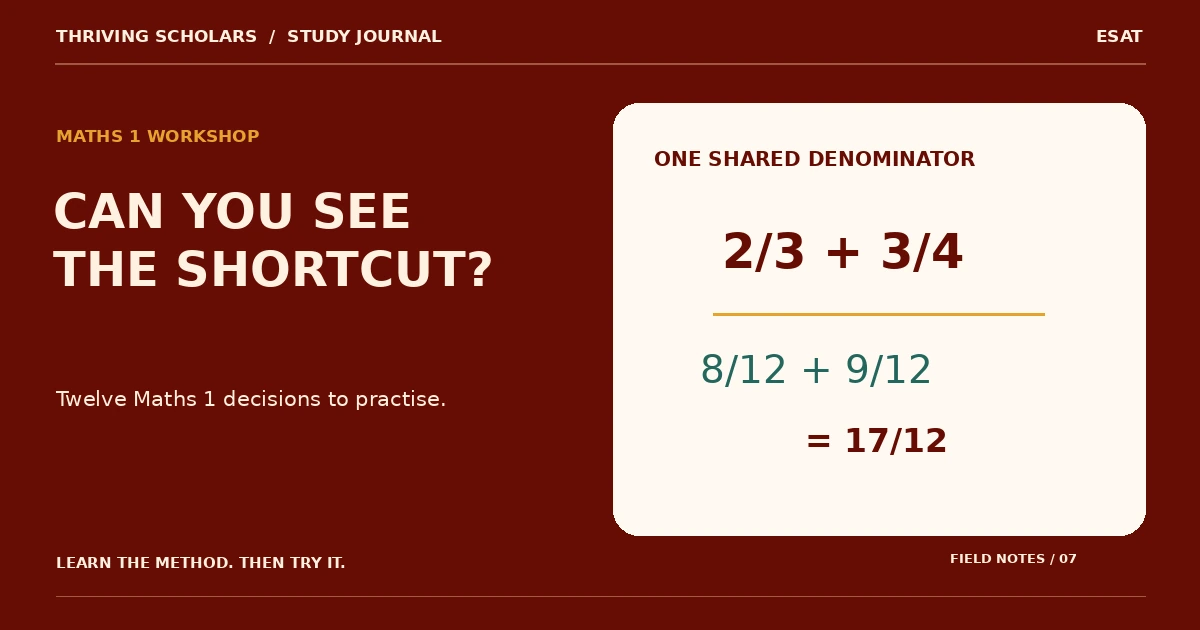
12-question Maths 1 diagnostic

Original Thriving Scholars practice. Suggested first-attempt time: 18 minutes, without a calculator. Review all twelve explanations afterwards.

Question 01 · Percentage multipliersA price is reduced by 20% and the reduced price is then increased by 12.5%. Compared with the original price, what is the overall change?
Need a hint?
Use a convenient original price, or multiply the two scale factors.
Worked solution

Answer: 10% decrease. The multiplier is (4/5) × (9/8) = 9/10. The final price is therefore 90% of the original. With an original price of £100, the two stages are £80 and £90.

Trap: subtracting 12.5 from 20 treats both changes as percentages of the same amount. The increase applies to the reduced price.

Question 02 · Linking ratiosPositive quantities satisfy a:b = 3:5 and b:c = 10:7. If a + b + c = 69, what is c?
Need a hint?
Make the two representations of b agree before using the total.
Worked solution

Answer: 21. Rewrite a:b as 6:10. The combined ratio is a:b:c = 6:10:7, containing 23 parts. Each part is 69/23 = 3, so c = 7 × 3 = 21.

A longer algebraic route works, but the shared quantity b makes a common ratio particularly efficient. Adding 3, 5, 10 and 7 would count incompatible units of ratio.

Question 03 · Decimal structureWhat is the value of (0.0048 × 750) ÷ 0.06?
Need a hint?
Divide 0.0048 by 0.06 before multiplying by 750.
Worked solution

Answer: 60. Since 0.0048/0.06 = 0.08, the expression is 0.08 × 750 = 60. Equivalently, 8% of 750 is 60.

Check: 0.0048 × 750 = 3.6, and dividing by a number smaller than 1 increases the result. Answers below 3.6 are therefore impossible. Keep track of powers of ten rather than moving decimal points by eye.

Question 04 · RatesOne tap fills 3/5 of an empty tank in 18 minutes. A drain empties 1/4 of a full tank in 15 minutes. Both operate at constant rates. Starting with an empty tank, how long does filling take with the tap and drain both open?
Need a hint?
Express both changes as fractions of a whole tank per minute.
Worked solution

Answer: 60 minutes. The tap adds (3/5)/18 = 1/30 tank per minute. The drain removes (1/4)/15 = 1/60 tank per minute. Their net rate is 1/30 − 1/60 = 1/60, so one tank takes 60 minutes.

The tap alone would fill the tank in 30 minutes; opening a drain must make filling slower. The constant-rate assumption is part of the mathematical model.

Question 05 · SimilarityTwo solid containers are geometrically similar. Their surface areas are in the ratio small:large = 9:16. The smaller container has volume 81 cm3. What is the volume of the larger?
Need a hint?
Take the square root of the area ratio, then cube the length ratio.
Worked solution

Answer: 192 cm3. The length ratio is 3:4, so the volume ratio is 27:64. The larger volume is 81 × 64/27 = 3 × 64 = 192 cm3.

Trap: multiplying by 16/9 applies an area scale factor to a volume. Writing length, area and volume factors in a short row helps keep their powers separate.

Question 06 · Arithmetic sequencesAn arithmetic sequence has sixth term 23. The sum of its fourth and ninth terms is 52. What is its tenth term?
Need a hint?
Write the fourth and ninth terms relative to the sixth term.
Worked solution

Answer: 47. If the common difference is d, the fourth term is 23 − 2d and the ninth is 23 + 3d. Their sum is 46 + d = 52, giving d = 6. The tenth term is four steps after the sixth: 23 + 4 × 6 = 47.

This avoids first finding the initial term. If you do find it, it is −7; a negative initial term is entirely consistent.

Question 07 · Probability without replacementA bag contains four red, three blue and two green counters. Two counters are selected uniformly at random without replacement. What is the probability that they have the same colour?
Need a hint?
Count the favourable unordered pairs, then all unordered pairs.
Worked solution

Answer: 5/18. There are 4 × 3/2 = 6 red pairs, 3 × 2/2 = 3 blue pairs and one green pair: ten favourable pairs. There are 9 × 8/2 = 36 possible pairs, giving 10/36 = 5/18.

Alternatively, add (4/9)(3/8) + (3/9)(2/8) + (2/9)(1/8). Using the same denominator 9 for the second draw incorrectly assumes replacement.

Question 08 · Coordinate geometryA = (1, 2) and B = (7, 10). The perpendicular bisector of AB meets the x-axis at P. What is the x-coordinate of P?
Need a hint?
Find the midpoint and the negative reciprocal of the gradient of AB.
Worked solution

Answer: 12. The midpoint is (4, 6). AB has gradient 8/6 = 4/3, so its perpendicular bisector has gradient −3/4. Its equation is y − 6 = (−3/4)(x − 4). Setting y = 0 gives x − 4 = 8, hence x = 12.

Geometric check: moving eight units right from the midpoint lowers the line by six units, exactly reaching the x-axis.

Question 09 · Bounds and structureReal numbers x and y can vary independently, with 2 ≤ x ≤ 5 and 3 ≤ y ≤ 7. What is the largest possible value of (x + y)/x?
Need a hint?
Rewrite the expression as 1 + y/x.
Worked solution

Answer: 9/2. We have (x + y)/x = 1 + y/x. Since both variables are positive, the ratio is largest when y is largest and x is smallest: 1 + 7/2 = 9/2. The allowed pair (x, y) = (2, 7) attains it.

Maximising x + y first gives the wrong strategy because changing x also changes the denominator. Optimise the whole expression.

Question 10 · Weighted proportionsIn a club, 2/3 of the girls and 1/4 of the boys wear glasses. Overall, 5/12 of the members wear glasses. The club contains only girls and boys. What fraction of all members are girls?
Need a hint?
Let the girl fraction be g and the boy fraction be 1 − g.
Worked solution

Answer: 2/5. Let g be the fraction of members who are girls. Then (2/3)g + (1/4)(1 − g) = 5/12. Multiplying by 12 gives 8g + 3 − 3g = 5, so 5g = 2 and g = 2/5.

The overall percentage is a weighted average. Simply taking the mean of 2/3 and 1/4 would assume equal numbers of girls and boys.

Question 11 · Strict inequalitiesA triangle has side lengths x + 1, x + 4 and 2x − 1, where x is a positive integer. Its perimeter is less than 40. How many values of x are possible?
Need a hint?
Check the triangle inequalities as well as the perimeter.
Worked solution

Answer: 6. The restrictive triangle inequality is (x + 1) + (2x − 1) > x + 4, giving x > 2. The other two triangle inequalities add no stronger restriction. The perimeter is 4x + 4 < 40, so x < 9. Thus x can be 3, 4, 5, 6, 7 or 8.

At x = 2 the sides form a straight, degenerate shape, not a triangle. At x = 9 the perimeter equals 40, which is excluded.

Question 12 · Systematic casesThree distinct positive integers have sum 12. Their product is divisible by 10. What is the greatest possible product?
Need a hint?
A factor of 5 must appear in one integer. Decide which multiples of 5 are possible.
Worked solution

Answer: 60. One integer must be a multiple of 5. It cannot be 10, because the other two positive integers would both have to be 1, violating distinctness. Therefore one integer is 5. The other two sum to 7: the unordered pairs are (1, 6), (2, 5) and (3, 4). The middle pair repeats 5 and is invalid. The remaining products are 30 and 60, so the maximum is 60.

Checking all valid cases proves the maximum; finding one divisible product does not.

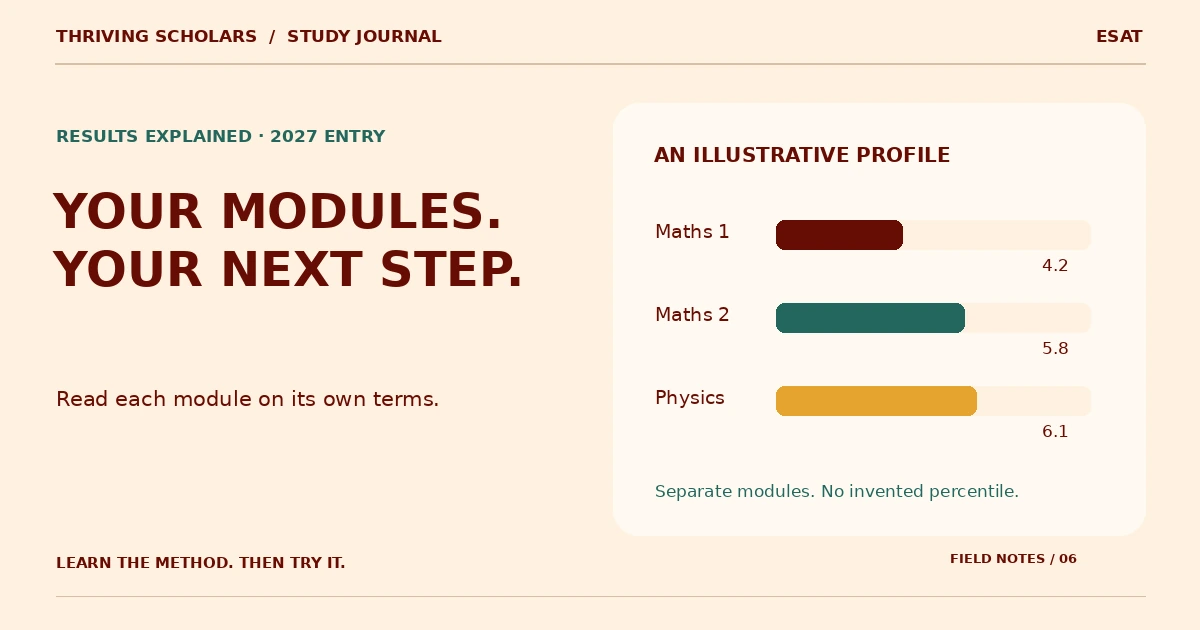
Your mark is a result on this short diagnostic only. Use the topic labels and explanations to plan practice; it is not an official or predicted ESAT score.

Read the pattern behind the mark

The total is less useful than the explanation. An 8/12 with four unfamiliar ideas calls for a different week from an 8/12 with two sign errors and two questions never reached. Do not turn this short set into a scaled ESAT prediction.

What happened?Likely bottleneckNext useful task
You could not start, even untimed.Knowledge or representation.Revise the concept; solve three short variations and explain the first step.
You solved it correctly after the timer.Fluency or selection.Compare methods, then solve an unfamiliar variation under gentle timing.
Your method worked but the answer did not.Execution or interpretation.Identify the exact sign, unit, denominator or condition that changed the result.
You never reached a solvable question.Time allocation.Practise leaving an unproductive route and returning later.

Classify the first cause, not merely the final symptom. “Arithmetic error” is incomplete if the arithmetic became difficult because you expanded a ratio expression that could have cancelled.

Three changes that remove unnecessary working

1. Preserve ratios before substituting numbers

In Question 5, surface areas give a length ratio and then a volume ratio. Keeping those as 3:4 and 27:64 avoids inventing dimensions for containers whose exact shapes are irrelevant. The same habit helps with rates and percentage multipliers.

2. Work relative to a useful reference point

In Question 6, the known sixth term is the natural reference point. Writing the other terms relative to 23 immediately exposes the common difference. Finding the first term is valid, but it is extra work that the question never asks you to do.

3. Make the restriction visible

Questions 11 and 12 are traps for incomplete reasoning. Write “strict”, “positive” or “distinct” beside the part of the calculation it affects. These tiny annotations prevent an apparently good answer from including an invalid boundary or repeated integer.

A flexible routine for a 40-minute module

Study suggestion: divide your decisions into three stages. First, collect questions for which you can see a reliable route. Second, revisit problems where a route exists but takes more work. Finally, check unanswered items and vulnerable answers. Practise this before using it in an assessment.

Do not skip solely because a question looks long. A long statement may contain a short ratio argument; a short equation may require several cases. Ask “What is my next useful step?” If you cannot name one after a reasonable attempt, mark the question and move on.

Equally, do not abandon a nearly finished calculation merely because a rigid stopwatch target has passed. Time management is a comparison: is completing this route more productive than examining the next unseen question? Avoid spending several minutes repeatedly trying the same unsuccessful algebra.

There is no penalty for incorrect ESAT answers. Build a final check for blanks, using elimination where possible. This does not mean blind guessing should replace solving; it means an unanswered item should not be forgotten.

Use the next seven days to test whether your method improved

DayConcrete taskEvidence to keep
1Complete this diagnostic and classify every uncertain answer.Raw mark, labels and three recurring causes.
2Relearn the weakest concept, then solve three new short examples.A one-sentence explanation of the method.
3Practise your two slowest correct question types.Compare the original route with a shorter valid route.
4Try a mixed unfamiliar set, with time to review immediately.Whether you selected methods without topic labels.
5Revisit yesterday’s errors without looking at solutions.Whether the correction survives a delay.
6Complete an unfamiliar timed Maths 1 module.Questions reached, accuracy and time lost to stalled work.
7Compare error patterns and plan the next narrow repair.One change to retain and one still needing practice.

Use the official archive map to find additional suitable material. Reserve some unseen questions for reassessment. Repeating this same twelve-question set immediately can check your understanding, but familiarity makes its second timed result a poor measure of general speed.

Before you go

Common questions

Should I spend exactly 90 seconds on each question?
No. The average time is a reference, not a rigid rule. Some questions resolve quickly, and others justify more time when you have a reliable route.
Should I practise only hard questions?
No. Start with the difficulty at which your reasoning is sound, then add mixed problems and timing. Repeated avoidable errors on straightforward material also cost marks.
Is 12/12 a prediction of a high official score?
No. This is a short authored diagnostic covering selected skills, not a standardised assessment. A strong result is evidence about this set, not a calibrated admission-test prediction.
What should I do after guessing correctly?
Review the question. Explain why your answer is correct, why an alternative is wrong, and how you would approach an unfamiliar variation.
Can I use a calculator for these questions?
For the suggested diagnostic, work without one, matching the no-calculator ESAT format. Afterward, a calculator can check arithmetic, but the worked method should remain possible by hand.

Sources & further reading

Official rules and programme details can change. Use the linked source for your exact course, competition or examination session.

  1. UAT-UK: ESAT format and rulesCompulsory Maths 1, module length, question count, no-calculator rule and no negative marking.
  2. UAT-UK: ESAT preparation materialsOfficial guide and archived practice resources.