
What counts as a good ESAT score?
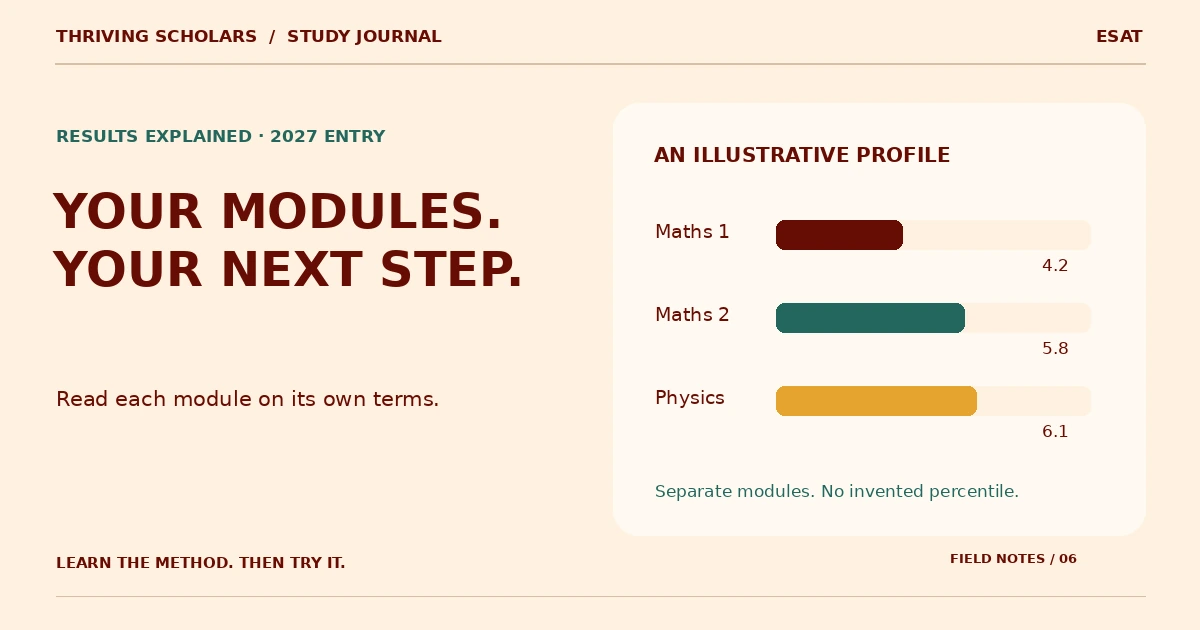
There is no single ESAT score that guarantees an interview or an offer. You receive a separate scaled result for every module you take, and universities consider those results alongside other application information. A useful question is therefore: what does this module profile show, and how does my chosen course use it?
UAT-UK’s ESAT guidance describes a 1.0–9.0 scale, reported to one decimal place, with no universal pass or fail. Calling every score below an arbitrary number a failure is misleading. Equally, calling a high result a guaranteed place ignores the rest of the selection process.
Use this page to separate three things: the meaning of your official result, the limited comparisons you can make with previous applicants, and the preparation or application decision you need to make next.
The scale is not a percentage
A score of 6.0 does not mean 60%, six correct answers, or six questions more than another candidate. Raw marks and scaled scores answer different questions. A raw mark counts correct responses on a particular set; a scaled score places performance on the reporting scale used for that test.
For historical context, UAT-UK’s explanation for the October 2025 and January 2026 sittings described typical scores around 4.5 and approximately 10% above 7.0. These are historical reference points, not an October 2026 percentile table or university entry requirements. Use the official explanation for your own sitting for current comparisons.
A one-point difference on this scale should not be casually translated into a fixed number of extra questions. Test versions can differ, and statistical equating is designed to support comparison. It is better to say “my Physics score is lower than my Maths 1 score” than to claim that a made-up conversion tells you exactly how many Physics questions you missed.
Explore your official module profile
Enter scores from an official results statement below. The display helps you see their positions on the published scale. It does not calculate admission chances, manufacture a combined ESAT result, or estimate scores from practice marks.
Consider two illustrative three-module profiles: 7.0, 7.0, 4.0 and 6.0, 6.0, 6.0. Both have arithmetic mean 6.0, but they describe different performances. Averaging them hides the third-module difference. A university can also consider modules in the context of its course, so your private average should never be presented as an official overall ESAT score.
When reviewing your own profile, write the module names beside the numbers. A note saying “Maths 1 6.0; Maths 2 5.4; Physics 6.7” is more informative than “I got about a six”. Keep any subsequent discussion tied to the actual course and admissions cycle.
Why a mock mark cannot tell you your exact ESAT score
Suppose you answer 18 of 27 questions correctly in a practice module. That is a useful result: it tells you which nine questions to review and gives you a baseline for a comparable future set. On its own, it cannot establish an official scaled score.
Two practice sets can contain very different levels of difficulty. Repeating a familiar set also measures recall as well as reasoning. A 20/27 on a repeated worksheet and a 17/27 on an unfamiliar, carefully timed module are not clean evidence of a decline.
UAT-UK intentionally does not award scaled scores for its specimen and sample tests; see its explanation of practice-test results. Treat a commercial score estimate as an estimate with stated assumptions, rather than an official conversion.
Better practice record: record the paper, whether it was unfamiliar, raw mark, time used, questions guessed and error types. Compare like with like. That record tells you what to change next, which is more useful than repeatedly refreshing an unofficial score calculator.
How to use university score information without overreading it
Imperial publishes historical admissions-test information by department and explicitly warns that it is not a statement of current or future requirements. It also explains that a high result does not guarantee success and a low result does not automatically mean rejection.
Before using any admissions table, check the year, department, applicant group and outcome. “Applicants”, “interviewed applicants”, “offer holders” and “students who enrolled” are different populations. A mean is also not a cutoff: values can lie on both sides of it.
| Evidence you find | Reasonable use | Unreasonable conclusion |
|---|---|---|
| A published historical average | Understand the broad context of that particular group. | Everyone below it was rejected. |
| A university’s current course requirement | Check which test and modules are required. | Every course at that university uses the same modules. |
| A student’s online result and offer | Understand one person’s experience. | Calculate your own probability of an offer. |
| A commercial practice estimate | Use cautiously if its assumptions are clear. | Treat it as your official ESAT result. |
If your course has not published a score threshold, leave that uncertainty visible. A precise-looking invented number is less useful than an accurate account of what is and is not known.
Results and January dates for this admissions cycle
For the 2027-entry cycle, UAT-UK’s deadlines page lists October results for 16 November 2026 (mid-afternoon GMT). The main January test window is 4–8 January 2027, with January results scheduled for 8 February 2027. Regional delivery dates can differ.
January booking closes on 21 December 2026 at 18:00 GMT. The access-arrangement request deadline is earlier, on 7 December at 18:00 GMT. Most Oxford and Cambridge applicants must use the October sitting; specified January-deadline exceptions apply. You can sit the test only once within an admissions cycle, so January is not a routine resit after October.
Read the current official dates before acting. Your next task depends on whether you are waiting for results, preparing for an eligible January sitting, or planning a later application cycle.
Choose the next action that actually helps
There is a practical difference between reviewing a result and trying to change a completed test. For a current application, keep meeting the university’s instructions and prepare for any remaining assessment. For a future sitting, turn uncertainty into a diagnostic question: which topic, method or timing decision is limiting your raw performance?
For example, if Maths 1 practice is accurate without a timer but incomplete under timed conditions, start with our Maths 1 timing diagnostic. If Physics errors begin before the calculation, use the Physics worked-problem lesson to check your choice of model and equation.
Common questions
Is 7.0 a guaranteed interview?
Should I average my three scores?
What official score is 18 out of 27?
Can I retake the ESAT in January after sitting in October?
Does a low result mean I should withdraw my application?
Sources & further reading
Official rules and programme details can change. Use the linked source for your exact course, competition or examination session.
- UAT-UK: ESAT overviewSeparate module scores, scale and test overview.
- UAT-UK: preparation guidanceScore-scale anchors and limitations of specimen-test results.
- UAT-UK: deadlines2027-entry results, bookings and test windows; checked 10 November 2026.
- UAT-UK: resultsOfficial result access and cycle-specific explanations.
- Imperial: understanding ESAT and TMUA scoresHistorical admissions data and limits on interpreting it.