Start with the official annotated archive
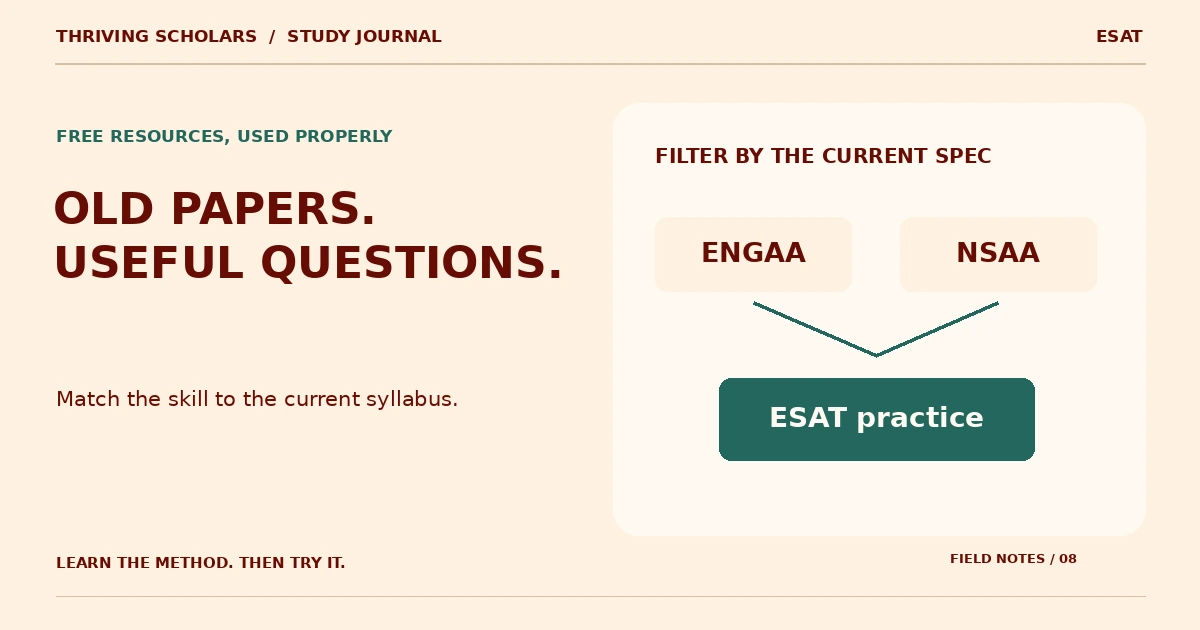
For ESAT preparation, begin with UAT-UK’s ESAT preparation materials. The page links to the five subject guides and historic ENGAA and NSAA question papers with answer keys. UAT-UK says it has indicated questions that fall outside the ESAT specification.
That matters because an archive can be authentic without every question being relevant to your test. A paper’s old title, section structure, time allowance and syllabus all belong to its original assessment. You are using it as a source of selected problems, not relabelling it as an official modern ESAT mock.
Use the map below to locate the right section quickly. Then keep the current module guide beside the paper and follow any official exclusion markings. If your local download is an old unannotated version, return to the official archive rather than assuming that every question is suitable.
The module-by-module paper map
This is a checked section map, not a claim that every item in each listed range is in scope. The ranges identify where questions are printed so you can find them reliably. Search by module or paper, open the official PDF, and apply the scope check before selecting your set.
For the other available years, enter through the official archive and read that paper’s contents page. Do not copy question ranges from one year onto another: section sizes and structures changed.
Two numbering changes that prevent wasted practice
The 2016 NSAA Section 1 paper has five parts with 18 questions per part, including a mixed advanced mathematics and physics part. The 2023 version has four parts with 20 questions each. Biology therefore does not start at the same printed question number in the two papers.
Likewise, ENGAA 2016 Section 1 contains 54 questions across its two mixed parts, whereas ENGAA 2023 Section 1 contains 40. A spreadsheet that assumes identical ranges for every year can silently assign questions to the wrong subject.
Keep a question’s identity as “exam + year + section + printed question number”. “Question 8” alone is not enough. If you extract a subset for your own notes, preserve the original references even when the new set numbers its items 1–10.
The four checks before you attempt an archived question
For example, an item may involve mathematics that you know well but depend on a physics concept you are not taking. It is not useful Maths 1 practice merely because there is a calculation. Conversely, a long science question may mainly expose weak proportional reasoning. Record both the subject knowledge and the method needed.
If the current guide does not support a required idea, mark the question as extension work and move on to relevant material. Extension questions can be enjoyable, but they should not consume the time you intended to spend repairing an assessed skill.
Build a practice route around your actual modules
Maths 1 + Maths 2 + Physics
Start with a Maths 1 diagnostic, then select mathematics from the appropriate NSAA or ENGAA sections. Keep a separate Maths 2 list from the advanced mathematics subset. Use NSAA Physics or the physics items within ENGAA for the third module. This separation makes a weak advanced-algebra result visible instead of burying it inside a mixed total.
Maths 1 + Chemistry + Biology
Use NSAA’s clearly labelled mathematics, chemistry and biology parts as the initial organisation. In Chemistry, distinguish chemical knowledge from numerical handling such as units and ratios. In Biology, distinguish factual knowledge from interpreting experimental evidence. The same wrong-answer count can require very different revision.
Maths 1 + Maths 2 + Chemistry
Use the mathematics and advanced-mathematics selections for the two maths modules, then NSAA Chemistry for the science module. Do not add Physics simply because it appears beside useful mathematics in ENGAA. Your required combination determines the practice plan.
These are practice examples, not a university requirement list. Use the course and module checker before committing to a pathway.
Use old papers for skills; use modern practice for the complete format
There are two useful modes. In learning mode, choose a small group around one weakness and allow time to understand the reasoning. In mixed practice mode, remove the topic labels, choose unfamiliar questions and work under a stated time limit. Keep those results separate.
As a study exercise, ten selected questions in about fifteen minutes can test whether your methods remain usable under pressure. This timing is a practice choice, not an official ESAT equivalence. Question selection changes the difficulty, and a hand-picked set can overrepresent your strongest topics.
Later, use the official specimen and practice materials linked from UAT-UK’s preparation page to become familiar with the present digital format. Supplement with suitable unfamiliar module practice. Do not use an old paper’s printed time allowance as if it were the current module timing.
If you have encountered a question before, mark it as familiar. A quick remembered solution is useful revision, but it should not be counted as independent evidence that you now solve unfamiliar problems at the same speed.
A review log that changes the next session
| Field | What to write | Why it helps |
|---|---|---|
| Source | Exam, year, section and original question number. | You can find and verify the item again. |
| Scope | Current module and the matching topic. | You know why the question belongs in your plan. |
| Attempt | Correct, wrong or guessed; approximate time. | A correct guess does not disappear from review. |
| First failure | Concept, representation, calculation, condition or timing. | You repair the cause rather than merely copy the answer. |
| Transfer task | A new question requiring the same idea. | You check understanding rather than recognition. |
An answer key gives the correct option; it does not by itself explain why your route failed. After checking it, write a complete argument and test its assumptions. If your answer disagrees, resolve the disagreement before practising the same method again.
For additional worked teaching, try the Maths 1 diagnostic and no-calculator Physics workshop. Their original problems model the kind of review you should apply to an archived question: a valid method, a shorter route where appropriate, and a named trap.
Common questions
Are ENGAA and NSAA papers still useful for the ESAT?
Which archive should I use for Biology and Chemistry?
Can I use every advanced question for Maths 2?
Why do question numbers change between years?
Can I convert my old-paper percentage into an ESAT score?
Sources & further reading
Official rules and programme details can change. Use the linked source for your exact course, competition or examination session.
- UAT-UK: annotated ESAT preparation archiveOfficial subject guides, question papers, answer keys and scope-annotation guidance.
- NSAA 2023, Section 1Verified four-part section map and printed question ranges.
- NSAA 2016, Section 1Verified five-part structure, 18 questions per part and advanced mixed section.
- ENGAA 2023, Section 1Verified two-part, 40-question mixed mathematics and physics structure.
- ENGAA 2016, Section 1Earlier 54-question structure demonstrates why ranges cannot be copied across years.
- UAT-UK: preparationOfficial current-format specimen and practice materials.