Maths 1 is common; the remaining requirement depends on the course
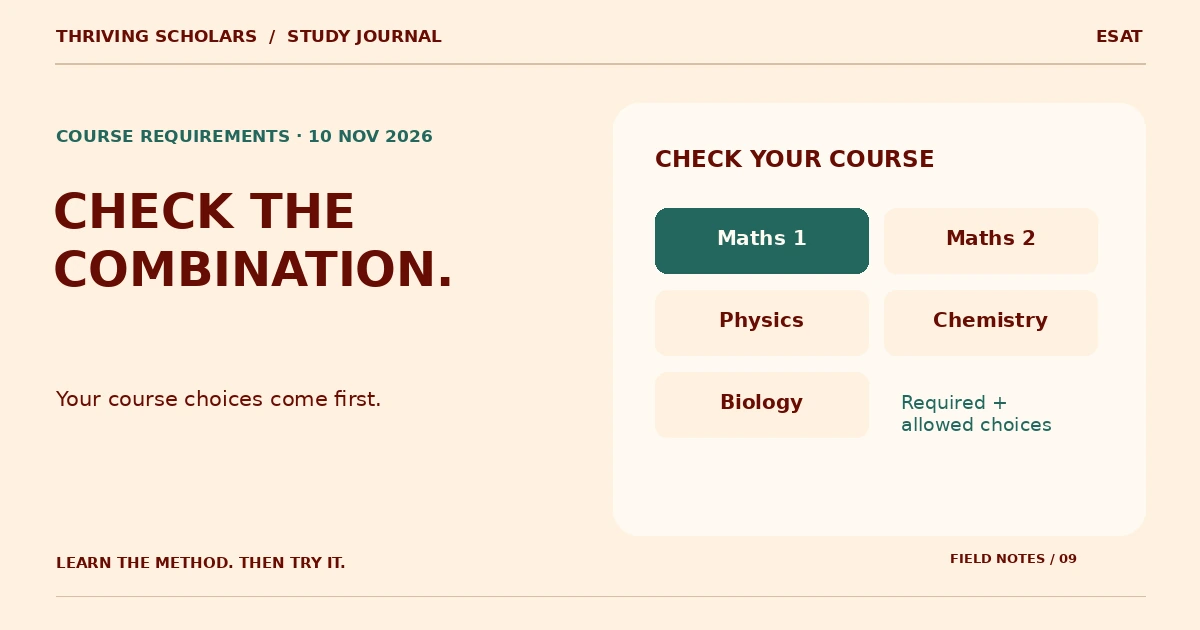
All ESAT candidates take Maths 1. What follows is course-specific: many routes require two more modules, while some specify a different number. The available subject modules are Maths 2, Physics, Chemistry and Biology. Check the exact degree and entry year before building a revision plan.
UAT-UK’s module-selection rules explain that a free choice for one course must accommodate compulsory requirements for another. Conflicting compulsory requirements need advice from UAT-UK before booking. You cannot solve the problem by quietly dropping a required subject.
The checker below covers selected verified routes, including clearly labelled department-level entries. It is a convenient planning aid. Open the linked official source for your exact degree, including any foundation, deferred-entry or other exception that applies to you.
Check the requirements across your shortlist
Select every relevant course you are considering, not just your first choice. The comparison distinguishes compulsory modules from permitted choices. A free-choice entry means the official course permits a choice; it does not mean the same choice will satisfy every other university on your list.
If you cannot find your exact course, use the university’s current admissions page rather than substituting the closest-sounding title. Similar subjects can have different requirements, and a university using ESAT for one department does not imply that every science or engineering degree uses it.
Three differences worth checking carefully
Imperial Design Engineering uses two maths modules
The Design Engineering MEng course page specifies Maths 1 and Maths 2. Its departmental FAQ explains that additional modules needed by another course are not considered for Design Engineering. Do not add a science module solely because you assume every ESAT sitting has three modules.
Imperial Chemical Engineering requires Chemistry
The Chemical Engineering MEng page specifies Maths 1, Maths 2 and Chemistry. This differs from the Maths 1, Maths 2 and Physics combination used by several other engineering departments. The word “engineering” alone is not enough to select a pathway.
A course can permit any two additional modules
Cambridge’s ESAT guidance allows a choice for Natural Sciences, Chemical Engineering and Biotechnology, and Veterinary Medicine. Oxford Biomedical Sciences and UCL Electronic and Electrical Engineering also list Maths 1 plus two choices from the other four modules. Check whether another application removes that freedom.
Three worked shortlist examples
Example 1: UCL Electronic and Electrical Engineering + Cambridge Engineering
UCL permits Maths 1 plus any two of the other four modules. Cambridge Engineering requires Maths 1, Maths 2 and Physics. Choosing Maths 2 and Physics therefore satisfies both module requirements. The Cambridge application also affects which sitting is acceptable; a permissive January option at UCL does not override it.
Example 2: Imperial Design Engineering + Imperial Chemical Engineering
Design Engineering requires the two maths modules. Chemical Engineering adds Chemistry. The combined requirements are Maths 1, Maths 2 and Chemistry. The extra Chemistry result is needed for the Chemical Engineering application, not to strengthen the Design Engineering requirement.
Example 3: Cambridge Engineering + Imperial Chemical Engineering
The first requires Physics alongside the two maths modules; the second requires Chemistry. This creates conflicting compulsory subject requirements. Contact UAT-UK before booking. Do not interpret the union of four module names as automatic permission to book four, and do not assume a university will accept a substitute.
A selection tool can reveal a conflict; it cannot approve an exception. Keep the official response with your booking records if you need personalised guidance.
If you genuinely have a choice, use evidence rather than reputation
Once every course requirement is satisfied, compare the remaining permitted options using three kinds of evidence. First, check coverage: which required topics have you already studied? Second, check accuracy on unfamiliar questions. Third, check how well that accuracy survives a time limit.
A subject that feels easier in school may still demand unfamiliar calculations or rapid interpretation in the ESAT. Equally, one poor first diagnostic can reflect a small topic gap that is inexpensive to repair. Avoid choosing from a single score before reviewing its cause.
Study suggestion: take a short unfamiliar set in each genuinely available module. Use comparable conditions and log concept gaps, calculation errors and timing problems. Review those errors, then try a second set. Choose using your overall preparation position and the time available, rather than the most flattering single result.
Do not interpret unofficial grade conversions as proof that one module is objectively easier. Different topics, test versions and groups of candidates complicate that comparison. Your own ability to complete relevant, unfamiliar work is a more useful planning input.
The right modules do not fix the wrong test sitting
For 2027 entry, the main January window is 4–8 January 2027. Most Cambridge and Oxford applicants must have taken the October sitting; specific January-deadline exceptions apply. As this guide is checked on 10 November 2026, the main October window has already passed. January is not a general substitute for a missed October requirement.
Use UAT-UK’s central deadlines page for booking and support deadlines. It lists January booking closing at 18:00 GMT on 21 December 2026, with earlier deadlines for access arrangements and bursaries. China, Hong Kong and Macau have narrower delivery dates than the main global window.
If you are reading for a later entry year, recheck the next cycle when its requirements are published. This table is deliberately labelled 2027 entry; it does not assume that every rule stays unchanged indefinitely.
A five-minute check before you confirm the booking
After booking, save the confirmation and compare it with your course list while there is time to resolve an error. UAT-UK says changing modules requires cancelling and rebooking; availability and deadlines therefore matter. Ask for advice promptly rather than relying on a change at the test centre.
Once the combination is correct, make the preparation equally specific. Use the archive map to find the right subject material, then allocate time according to your diagnostic results. Your study plan should follow the modules you will actually take.
Common questions
Does every ESAT applicant take three modules?
Can I choose the subjects in which I expect the best score?
What if two courses require different science modules?
Can I change modules on test day?
Does UCL require Physics for its Electronic and Electrical Engineering ESAT?
Sources & further reading
Official rules and programme details can change. Use the linked source for your exact course, competition or examination session.
- UAT-UK: ESAT module-selection rulesCompulsory Maths 1, cross-course choices, conflicts and booking changes.
- Cambridge: ESAT requirementsEngineering fixed modules and flexible choices for three other named courses.
- Imperial: ESAT department tableNamed department requirements.
- Imperial: Design Engineering MEngTwo-module requirement.
- Imperial: Design Engineering application FAQTreatment of additional modules required by other courses.
- Imperial: Chemical Engineering MEngMaths 1, Maths 2 and Chemistry.
- Oxford: Engineering ScienceFixed maths and Physics combination.
- Oxford: PhysicsFixed maths and Physics combination.
- Oxford: Physics and PhilosophyFixed maths and Physics combination.
- Oxford: Biomedical SciencesMaths 1 plus two optional modules.
- UCL: Electronic and Electrical Engineering ESATH600/H601 modules, entry years and named exceptions.
- UAT-UK: deadlinesCurrent test-window, booking and support deadlines.