Your first move: collect what the question gives you
When a long question feels unfamiliar, resist searching immediately for a memorised template. Underline the domain, write down the definitions and identify what the preceding part has already established. A new symbol often names something simple; a suggested substitution often reveals the structure the question wants you to use.
The two investigations below are original practice for AA HL problem-solving. They are not an official paper or a forecast of an examination. Attempt each part before opening the solution. A calculator can check arithmetic and roots, but the key conclusions require written reasoning.
Students taking current AA examinations should use the requirements for their own cohort. The announced redevelopment of the AA course has its first assessment in May 2029; it should not be treated as a replacement syllabus for 2027 examinations. See the IB course update.
Investigation 1: a recurrence with a hidden geometric sequence
A sequence is defined by u0 = 0 and
- Find u1, u2 and u3 exactly.
- Prove that 0 ≤ un < 2 for all n, and that the sequence is strictly increasing.
- Define vn = (un − 2)/(un + 1). Find a recurrence for vn and deduce an explicit formula for un.
- Find the smallest integer n for which 2 − un < 10−3.
- For a positive integer N, find the product (u0 + 2)(u1 + 2)…(uN−1 + 2).
- Now replace u0 = 0 with u0 = s, where s ≥ 0. Find uN in terms of s. Find its derivative with respect to s at s = 0 and explain the behaviour of this derivative as N increases.
Hint 1: how do you prove the bound?
Calculate 2 − un+1 in terms of un. To prove increasing behaviour, calculate un+1 − un and factor the numerator.
Hint 2: why the unusual transformation?
The values 2 and −1 are fixed points of the recurrence. Compute un+1 − 2 and un+1 + 1 separately before dividing.
Complete solution to Investigation 1
(a) Substitution gives u1 = 1, u2 = 5/3 and u3 = 21/11. Keep the fractions: they make exact checking easier.
(b) Suppose 0 ≤ un < 2. The numerator and denominator defining un+1 are positive. Also 2 − un+1 = (2 − un)/(un + 2) > 0. Thus the bound is preserved. Since u0 = 0 satisfies it, induction establishes the bound for every n.
Every factor has the required sign on the established interval, so the sequence is strictly increasing. Calculating several increasing terms would suggest this claim, but would not prove it.
(c) The transformed numerator is (un − 2)/(un + 2), while the transformed denominator is 4(un + 1)/(un + 2). Hence vn+1 = vn/4. Since v0 = −2, we have vn = −2/4n. Solving v = (u − 2)/(u + 1) for u gives u = (2 + v)/(1 − v), so
(d) Therefore 2 − un = 6/(4n + 2). The required inequality becomes 4n > 5998. Since 46 = 4096 and 47 = 16384, the smallest integer is n = 7. Checking both neighbouring integers prevents a rounding error in a logarithmic calculation.
(e) Add 2 to the explicit formula:
Consecutive numerator and denominator factors cancel. The product is therefore (4N + 2)/3. Notice the final index: the product contains N factors, ending at N − 1.
(f) With the new initial value, v0 = (s − 2)/(s + 1), so vN = (s − 2)/[4N(s + 1)]. Set r = 4N. Substitution into u = (2 + v)/(1 − v) gives
The denominator is positive for s ≥ 0 and N ≥ 0. Differentiating the quotient yields
At s = 0 this is 9r/(r + 2)². As N increases, r tends to infinity and the derivative tends to zero. For small changes near s = 0, the later term becomes less sensitive to the initial value. This is a local sensitivity statement; it is not an assertion that the derivative is zero for a finite N.
Investigation 2: the best endpoint is not the highest point
For x ≥ 1, define f(x) = ln(x)/x. For b > 1, define its average value on the interval [1, b] by
- Find the maximum value of f and the x-coordinate where it occurs.
- Show that M(b) = (ln b)²/[2(b − 1)]. Find its limit as b approaches 1 from above.
- Show that an interior stationary point of M satisfies 2(b − 1) = b ln b.
- Prove that M has exactly one stationary point for b > 1 and that it is a global maximum. Show that its position lies between e and e².
- Starting from b = 5, use Newton’s method twice to estimate the maximizing endpoint. Find the maximum average to three significant figures and show that M(b) = f(b) at the optimum.
- Let p > 0 and replace f with fp(x) = (ln x)p/x. Find the equation for the maximizing endpoint of its average on [1, b]. Prove that this endpoint lies between ep and ep+1.
Hint 1: separate integration from optimisation
Use t = ln x to integrate. For the derivative of M, keep a factor of ln b outside the bracket so that the remaining expression controls its sign.
Hint 2: how can you prove uniqueness?
Study g(b) = 2(b − 1) − b ln b. Its derivative is simpler than M′. Be careful: b = 1 is a boundary value, excluded from the domain of M.
Complete solution to Investigation 2
(a) Differentiating gives f′(x) = (1 − ln x)/x². The denominator is positive; the numerator changes from positive to negative at x = e. Thus f has global maximum 1/e at x = e.
(b) Since the derivative of ln x is 1/x, the integral is (ln b)²/2. Division by the interval width gives the stated formula. To evaluate the boundary limit, write M(b) = ½[ln b/(b − 1)]ln b. The first factor in brackets tends to 1 by the derivative of ln x at 1, while ln b tends to zero. Hence M(b) tends to 0.
(c) The quotient rule gives
For b > 1, all factors outside the square bracket are positive. Thus a stationary point satisfies g(b) = 2(b − 1) − b ln b = 0.
(d) We have g′(b) = 1 − ln b. Thus g increases strictly on (1, e) and decreases strictly on (e, ∞). Although g(1) = 0, b = 1 is outside M’s domain. Moreover, g(e) = e − 2 > 0 and g(e²) = −2 < 0. Continuity and strict decrease give exactly one root in (e, e²), with no other root for b > 1. Therefore M′ is positive before that root and negative after it, proving a global maximum.
(e) Newton’s iteration is
Starting from 5 gives 4.922568713 after one step and 4.921553811 after two. The maximizing endpoint is approximately 4.92155. Its average is approximately 0.323805119, or 0.324 to three significant figures. At the optimum, 2(b − 1) = b ln b; substituting into M gives M(b) = (ln b)²/(b ln b) = ln b/b = f(b).
This identity has a useful interpretation. Increasing b adds a thin extra piece whose height is approximately f(b). If that height exceeds the current average, the average increases. At the optimum, the new edge and current average balance.
(f) Substitute t = ln x again. The integral becomes (ln b)p+1/(p + 1), so
Its derivative has the sign of h(b) = (p + 1)(b − 1) − b ln b. We have h(1) = 0 and h′(b) = p − ln b. Therefore h increases up to ep and decreases thereafter. Also h(ep) = ep − p − 1 > 0: for p > 0, the integral of et from 0 to p exceeds the integral of 1, giving ep − 1 > p. At the other endpoint, h(ep+1) = −(p + 1) < 0.
There is exactly one root in (ep, ep+1). It satisfies (p + 1)(b − 1) = b ln b and gives the unique global maximum of the average. The maximum of fp itself occurs at ep, so the best averaging endpoint comes later.
See why maximising the average changes the answer
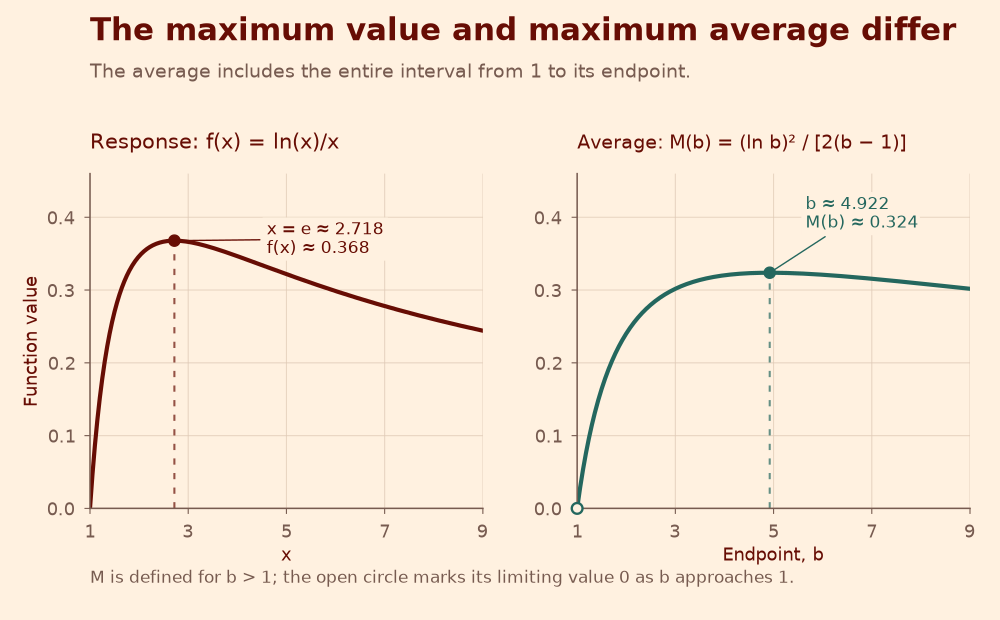
The response curve peaks at e ≈ 2.718, but its average over [1, b] peaks later, near 4.922. The average initially includes low values close to x = 1. Adding values after the response’s peak can still improve that average while the added values remain above it.
A graph is useful for forming the conjecture. The derivative and sign argument establish it. In an unfamiliar problem, these two roles work together: a sketch suggests where to look, and an exact argument explains why the answer is reliable.

How to review an extended solution
After finishing, identify the first part where your independent reasoning stopped. Classify the cause: an algebraic manipulation, a theorem, a domain restriction or a connection to an earlier result. Repeat that part with the solution hidden, then explain how it supports the next part.
In Investigation 1, the transformation unlocks the formula, error threshold, product and sensitivity. In Investigation 2, the derivative of the simpler helper function establishes uniqueness and the global maximum. These are transferable moves: transform an awkward object, or study a simpler expression with the same relevant sign.
Study suggestion: return to one investigation after a few days. Change the required error threshold in the recurrence, or use p = 2 in the average-value problem. Rebuilding the argument is a better check of understanding than recognising the printed solution.
Common questions
Do I need a new trick for every Paper 3 question?
Are these two investigations a complete official-length mock?
Why is checking a few sequence terms not a proof?
Can a graph prove that an optimum is unique?
Does the announced maths redevelopment apply to 2027 exams?
Sources & further reading
Official rules and programme details can change. Use the linked source for your exact course, competition or examination session.
- IB Mathematics AA curriculum updateFirst assessment date for the redeveloped AA course. All investigations and solutions in this article are original.