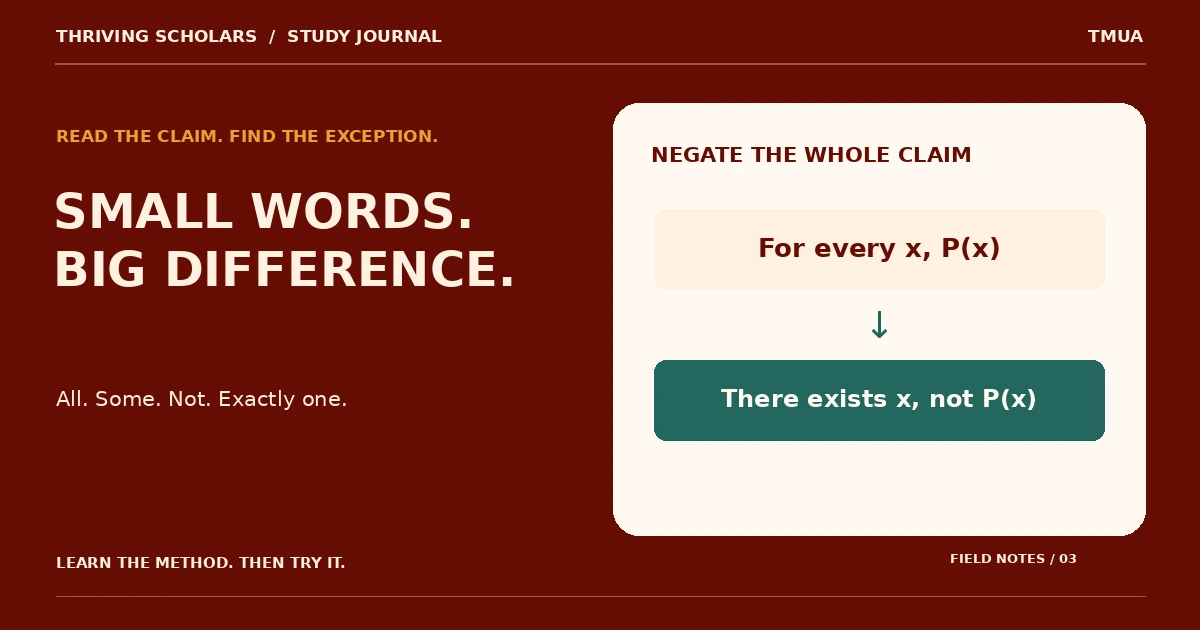
Negation means “when this entire claim fails”

Consider “Every number in the list is positive.” You can disprove it by finding one number that is zero or negative. You do not have to show that every number is negative. This small distinction explains many attractive wrong options.

Read the domain first: integers, real numbers, positive values or a specified list. Keep that domain when negating. Then identify the quantifier and the condition. A good negation covers every way the original can fail and none of the ways it can still be true.

Three moves to use before choosing an answer

Every → at least one exception

“Every x has P” becomes “some x does not have P”. You need a witness, not a universal opposite.

Some → no examples

“Some x has P” becomes “every x lacks P”. One unsuccessful example cannot disprove existence.

For a conditional, identify the premise and conclusion. “If A then B” fails when A is true and B is false. Preserve the boundary: the negation of x>2 is x≤2; the negation of x≥2 is x<2. Equality must belong to one side.

With nested claims, work from the outside inward. Do not swap the order of the variables. “For every x there exists a y” allows y to depend on x; “there exists a y for every x” requires one choice that works for all x.

Try the twelve traps

Try it here

Twelve ways a statement can mislead you

Original Thriving Scholars practice. Choose one answer per question, then check your reasoning. Hints and worked explanations are available for every item.

Question 01 · Universal claimWhich is the negation of “For every real x, x² ≥ x”?
Need a hint?
Look for one exception, not failure everywhere.
Worked solution

A universal claim fails when at least one permitted value fails the condition. The correct negation is “there exists a real x with x² < x”. For example x=1/2 gives 1/4 < 1/2. Requiring every x to fail is much stronger and is not the negation.

Question 02 · DomainNegate: “There exists an integer n for which n² = 2.”
Worked solution

An existence claim fails only when no allowed object works. Keep “integer”: replacing it with “real” changes the domain. The original statement is false, and its correct negation is true. Finding one integer that fails does not rule out all the others.

Question 03 · Nested quantifiersNegate: “There exists a real a such that, for every real x, (x−a)² ≥ 1.”
Worked solution

The outer “there exists” becomes “for every”; the inner “for every” becomes “there exists”; ≥ becomes <. For each a, choosing x=a gives zero, so the negation is indeed true. The same x need not work for every a.

Question 04 · Counting languageWhich statement negates “At least two of a, b and c are positive”?
Worked solution

“At least two” allows two or three. Its complement allows zero or one: at most one. “Exactly one” misses the case in which none are positive. Remember that a non-positive number can be negative or zero.

Question 05 · Order and boundaryNegate: “For every positive real ε, there exists a positive integer n such that 1/n < ε.”
Worked solution

Keep the order of the objects. A failure means there is one positive ε for which no permitted n works. Thus every positive integer n has 1/n ≥ ε. The weak inequality is essential: the negation of < includes equality.

Question 06 · ImplicationFor an integer n, which condition contradicts “If n is divisible by 6, then n is divisible by 3”?
Worked solution

An implication fails only when its premise holds and its conclusion fails. The required condition is divisible by 6 and not by 3. No integer actually meets it, which is consistent with the original implication being true. A logically correct negation need not describe an existing integer.

Question 07 · DependenceWhich statement is true over the real numbers?
Worked solution

For each chosen x, select y=−x. This proves the second statement. A single y cannot cancel both x=0 and x=1, so the first fails. Quantifier order controls whether your choice may depend on an earlier value.

Question 08 · ExistenceLet S be the empty set. Which statement is true?
Worked solution

The universal statement is true because there is no element of S that violates it. This is vacuous truth. It makes no existence claim. The other statements all require at least one element, which an empty set does not have.

Question 09 · Exactly oneWhat is the negation of “Exactly one of P and Q is true”?
Worked solution

The original allows the two mixed cases: true/false and false/true. Its negation consists of the remaining cases: true/true and false/false. “Exactly one is false” describes the same mixed cases as the original, not its negation.

Question 10 · CounterexampleWhich value is a counterexample to “For every positive integer n, n²+n+11 is prime”?
Worked solution

At n=10 the expression is 100+10+11=121=11², which is composite. The other listed values give 13, 17 and 41. One counterexample disproves the universal claim; several confirming examples never prove it for all positive integers.

Question 11 · Some and noneNegate: “Some triangles are isosceles.”
Worked solution

“Some” means at least one. Its negation is none. The existence of a non-isosceles triangle does not contradict the existence of an isosceles triangle: both statements can be true.

Question 12 · Layered statementNegate: “For every real x, if f(x)=0, then x>2.”
Worked solution

There must be at least one zero of f that violates x>2. The violating condition is x≤2, including the boundary x=2. The last option misses a possible counterexample exactly at 2.

The result describes this learning set only. Use missed topic labels to choose your next task.

Review an error in four lines

For each miss, write the original statement, its domain, the exact negation and a concrete example illustrating the distinction. For a true implication, explain what a counterexample would have to look like even if no such example exists.

A repair for the boundary trap

Original: every root is greater than 2. Negation: there is a root at or below 2. Test the boundary explicitly: a root at x=2 disproves the original, so any answer omitting equality is incomplete.

Return tomorrow to the questions you missed and reconstruct their logic before opening the options. Recognition of a remembered letter is not the same as understanding the sentence.

Connect the language to mathematical reasoning

The current TMUA specification includes quantifiers and negation within the logic strand. You are not required to use symbolic logic notation or complete formal truth tables. Accurate English and well-chosen mathematical examples are enough.

Continue with the necessary and sufficient conditions guide, then practise mixed reasoning where the question does not announce which rule it is testing. Within the TMUA Question Bank, select a focused reasoning topic and explain the wrong choices as well as the right one.

Study suggestion: exchange two statements with a study partner. Each person writes the negation and a boundary case. If you disagree, test a specific example before debating terminology.

Before you go

Common questions

Does “some” mean more than one?
In this context it means at least one. It may include every object in the domain.
What is the negation of “if A then B”?
A is true and B is false. Reversing the implication or negating only the conclusion while retaining “if” does not generally give its negation.
Can a universal statement about an empty set be true?
Yes. It is true when there is no counterexample in the domain. It does not establish that any object exists.
Do I need formal symbols for TMUA logic?
No. The specification says symbolic notation and formal truth tables are not required. You should be able to reason accurately with the statements in words.
How should I use the quiz score?
Use it to locate a language or boundary error, then practise a fresh example. It is not an official or predicted TMUA score.

Sources & further reading

Official rules and programme details can change. Use the linked source for your exact course, competition or examination session.

  1. TMUA specificationLogic, proof, quantifiers and notation scope.
  2. UAT-UK preparationOfficial Notes on Logic and Proof.