Yes, older questions can help—but choose them by skill
A question does not stop being useful because a syllabus changes. Conservation of atoms, concentration calculations and reasoning from experimental evidence remain powerful chemistry skills. What changes is where content sits, which depth is required and how the assessment combines those skills.
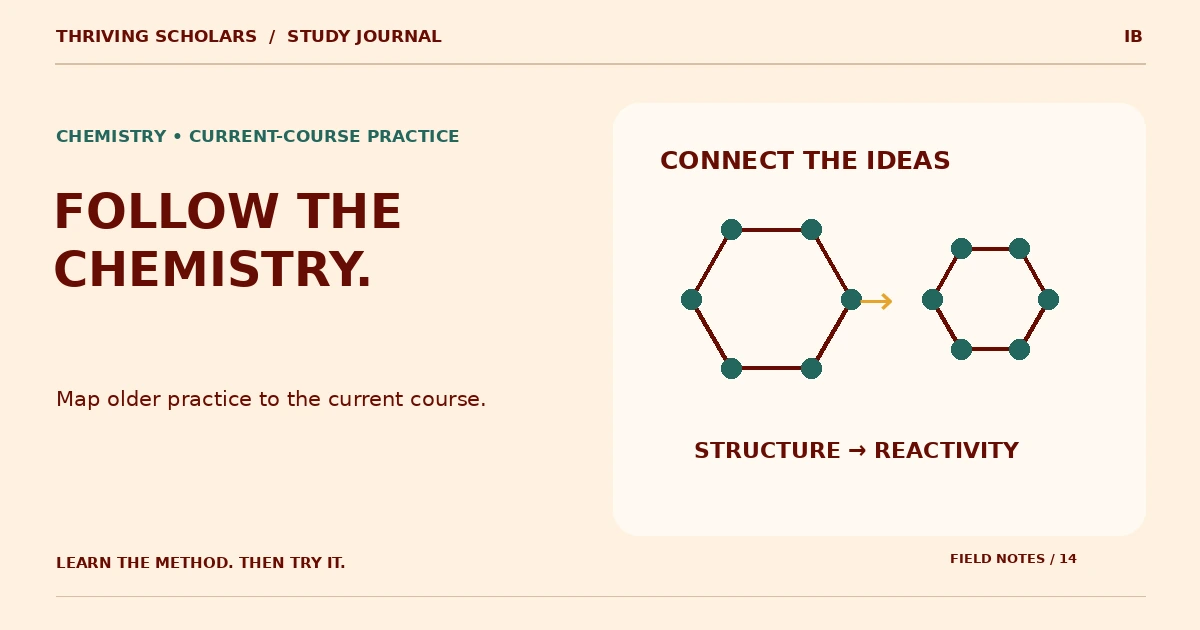
The current course, first assessed in 2025, is organised around structure and reactivity. The IB subject overview explains that organisation, and the subject brief summarises assessment. A familiar old chapter title is a starting clue; it is not enough to establish that every question in that chapter is appropriate.
Use older material to fill a specific learning need. If you are weak at converting volume to moles, choose relevant questions and review the conversion. If you are rehearsing the exact balance, timing and format of a current examination, use resources that actually match those conditions.
Apply three checks before you solve
- Name the skill. Write “calculate an initial rate from a tangent” or “deduce an equilibrium expression”. A broad label such as “kinetics” hides important differences.
- Locate the current requirement and level. Check the precise statement and its guidance. A topic can contain material common to SL and HL as well as additional HL work.
- Check the task and supplied information. An old problem may assume a different data booklet, an earlier part or an option-specific fact. Decide whether the question works as written or needs teacher-guided adaptation.
Then classify it as ready to use, use selected parts or set aside pending a syllabus check. This is a decision about the purpose of your practice, not a claim that an unfamiliar topic has no educational value.
If a question mixes useful calculation with an unnecessary specialised fact, practise the transferable part while clearly recording the limitation. Do not count that shortened exercise as a complete examination paper or compare its raw total with a grade boundary.
Searchable map: familiar topics to current codes
This selective map uses S for Structure and R for Reactivity. “SL + HL” refers to the specified statements; it does not mean that every question carrying the same broad topic name is suitable for SL. The code ranges and level distinctions were checked against the official Chemistry guide.
Search by a familiar word such as “equilibrium”, “organic” or “rate”. Once you locate the row, read the actual syllabus guidance before making a final decision about a particular question. The map is deliberately selective rather than a replacement for the full specification.
Three original examples: use the skill, check the scope
These questions are original demonstrations of the selection process. They are not copies or reworded versions of published past-paper questions. The first uses common quantitative skills; the second separates product knowledge from mechanism depth; the third illustrates an additional-HL calculation.
Build a useful 45-minute practice set
Study suggestion: choose three short questions on one weakness and one longer question that combines it with another skill. Spend 25 minutes solving, 10 minutes marking and 10 minutes repairing the first incorrect step in each solution. Keep a clear record of the current syllabus link.
For concentration practice, combine a direct mole calculation with a reaction ratio and a question about how an experimental error changes the result. This adds reasoning without requiring you to jump randomly between unrelated chapters. For rates, combine a graph calculation with a particle explanation; the two forms of understanding support one another.
After marking, distinguish a knowledge gap from a selection mistake. If you needed content outside the scope you intended to practise, your next action may be to choose a better question. If the content was appropriate but you used cm³ as though it were dm³, repair the unit conversion and try a fresh problem.
Keep some current-format resources unattempted for later timed rehearsal. A score on a paper you remember measures a different task from performance on an unseen paper. Older questions can expand the practice pool, but they should not replace the final check that you can handle your actual assessment format.
Avoid the “same chapter, same level” assumption
Equilibrium is a useful example. Writing an expression from a balanced equation and solving for an unknown equilibrium composition are related tasks, but they are not interchangeable demands. Similarly, identifying an organic functional group does not establish that a detailed spectral deduction has the same level designation.
Read multi-part questions one part at a time. An accessible opening can lead into additional depth. An SL student might use selected parts confidently while an HL student completes the whole set. Record what you attempted so that later review reflects the task you actually did.
When choosing an online question bank, check whether its filters use current topic labels and whether its level tags match individual questions. A large collection is most useful when you can find the right next question and understand why its solution works.
Common questions
Are all questions from older IB Chemistry papers obsolete?
Does a topic listed at SL and HL mean every question in it is SL?
Can I compare the score on an edited old paper with a grade boundary?
Should I practise current-format papers as well?
Where can I confirm a topic code?
Sources & further reading
Official rules and programme details can change. Use the linked source for your exact course, competition or examination session.
- IB Chemistry guide — first assessment 2025Current codes, level distinctions and the difference between alkene product equations and additional-HL mechanisms.
- IB Chemistry course overviewStructure and reactivity organisation.
- IB Chemistry subject briefFirst assessment date and assessment outline.