Start with the right course
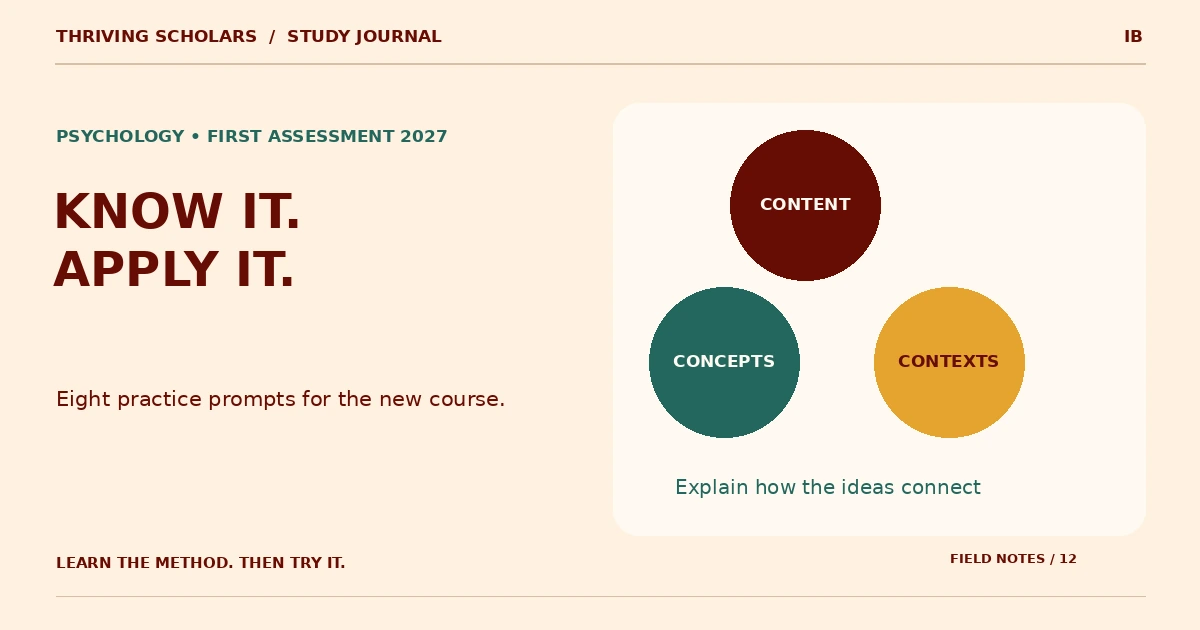
The revised IB Psychology course is first assessed in May 2027. Its organisation connects concepts, psychological content and applied contexts; the internal assessment is a research proposal. The official IB update explains the transition.
Older material can still help you understand a theory or examine evidence. Its value depends on the specific content and task. Do not assume that a complete older paper rehearses the current assessment, or that memorising a set of essays prepares you for every unseen situation.
| Current task | Useful revision action |
|---|---|
| Paper 1: knowledge, application and conceptual discussion | Explain ideas, apply them to new scenarios and develop a reasoned argument. |
| Paper 2: class practicals and unseen research | Review your own practicals and evaluate study design through concepts. |
| Paper 3: HL research-data interpretation | Connect quantitative and qualitative evidence to a justified conclusion. |
This summary follows the official guide. The six course concepts are bias, causality, change, measurement, perspective and responsibility. Use them to structure analysis, not merely as words to insert into a paragraph.
How to use these eight questions
These are original learning tasks, not official examination questions, a complete mock or predicted topics. The fictional research examples are labelled; they are not reports of actual studies. The model responses illustrate defensible reasoning, and alternative well-supported answers are possible.
Write your response before opening the model. Compare the explanation, application and conclusion rather than counting matching sentences. The success criteria are teaching checks, not an official examiner’s mark scheme. For longer answers, spend time planning the argument and make each example do analytical work.
Questions 1–4: knowledge and application
1. Explain a schema
Knowledge practice: Explain schema theory using one example of how a person interprets an unfamiliar situation.
Model response and success criteria
A schema is an organised mental framework built from prior experience. It helps a person select and interpret information by supplying expectations about what usually happens. It can make interpretation efficient, but it can also encourage assumptions when the current situation differs from those expectations.
For example, a student enters a new classroom, sees rows of desks and assumes the adult at the front is the teacher. That interpretation draws on a classroom schema. If the adult is a visiting parent, the same framework produces an incorrect conclusion. The example shows both the organising role of a schema and its potential to bias interpretation; it does not show that schemas always cause error.
Success criteria: Define the framework accurately; explain how prior experience influences interpretation; connect the example explicitly to that mechanism. Merely naming a classroom is not an explanation.
2. Describe observational learning
Knowledge practice: Describe observational learning using one example.
Model response and success criteria
Observational learning occurs when a person learns through attending to another person’s behaviour and its consequences. The learner must notice and retain the behaviour, have the capacity to reproduce it and have a reason to perform it. Learning a behaviour does not mean it will always be expressed.
Suppose a new club member watches a respected older student invite a quiet member into a discussion. The group responds warmly. The newcomer remembers the invitation and later uses it with another quiet member. The older student provides a model; the positive reaction can give the observer a reason to imitate the action. The example involves learning from a model rather than receiving a reward for the newcomer’s own initial behaviour.
Success criteria: Explain learning through a model; use the example to show observation and later behaviour; distinguish observing consequences from personally experiencing them.
3. A reward that stops working
Unseen-situation practice — learning and cognition: A revision app gives Mira a badge whenever she completes a practice set. She begins completing more sets. When badges are removed, she completes fewer. Explain these changes using operant conditioning.
Model response and success criteria
The badge is an added consequence following completion of a practice set. Because completion becomes more frequent, it can function as positive reinforcement for that behaviour. “Positive” refers to adding a stimulus, not to a judgment that the study method is beneficial.
After the badges are removed, the previously reinforced behaviour declines. That pattern is consistent with extinction when an expected reinforcer is no longer delivered. It is not negative reinforcement: negative reinforcement increases a behaviour by removing an aversive stimulus.
The scenario supports a plausible learning explanation, but does not establish that badges are the only influence. Mira’s workload or interest may also have changed. Furthermore, completing more sets does not necessarily mean she understood more: the reinforced behaviour is completion, while learning quality would require a separate measure.
Success criteria: Identify the behaviour and consequence; explain why the consequence counts as reinforcement; apply extinction to the removal; avoid confusing reinforcement with punishment or assuming improved understanding.
4. When more information becomes harder to learn
Unseen-situation practice — learning and cognition: A student revises from a screen containing an animated diagram, scrolling explanations and unrelated notification sounds. She can recall fewer details than when using a static, labelled diagram. Explain one possible account using cognitive load theory.
Model response and success criteria
Cognitive load theory considers the demands placed on limited processing resources during learning. The student must follow the changing diagram, locate the relevant written explanation and repeatedly redirect attention after notifications. These presentation demands can consume resources that could otherwise be used to understand the relationship between the diagram’s parts.
The static, labelled version may reduce unnecessary switching by placing relevant information together and allowing the learner to control the pace. This can leave more capacity for constructing a useful mental representation.
The explanation does not imply that animation is always harmful. A well-paced animation could clarify a process that a static image makes difficult to understand. Nor does this comparison isolate a single cause: movement, layout and notifications all changed. To investigate the notification effect, compare versions that are identical apart from notifications.
Success criteria: Explain limited processing resources; connect at least two scenario details to unnecessary demands; justify the proposed improvement; recognise that several features changed together.
Questions 5–6: conceptual discussion and method
5. Can one measure capture development?
Concept-based extended practice — human development: Discuss how measurement and perspective can influence conclusions about children’s language development.
Model response and success criteria
Conclusions about language development depend partly on what a researcher counts as language competence and whose expectations shape that choice. Measurement makes a construct observable; perspective influences which aspects of development seem important. Their interaction can produce useful comparisons, but can also make differences in experience look like differences in ability.
A standardised vocabulary task might count how many pictured objects a child names in one language. Its consistent instructions and scoring can improve reliability: different children face comparable tasks, and different scorers can apply the same rule. A repeated assessment may also reveal change over time. However, naming familiar objects captures only part of language use. Conversation, understanding, storytelling and adapting speech to another person may develop differently. A reliable vocabulary score is therefore not automatically a valid measure of every aspect of language development.
The research perspective affects interpretation. If a test treats one community’s vocabulary and interaction style as the default, a child from another linguistic environment may appear less capable because the examples are unfamiliar. A bilingual child may distribute knowledge across languages, while a single-language score records only some of that knowledge. This possibility does not prove every score difference is a testing artefact; it shows why information about exposure and language use matters before drawing a broad conclusion.
Naturalistic observation offers another perspective. Watching children communicate in a familiar setting can reveal abilities that a formal task misses. Yet observations are also selective. An observer must decide what counts as a successful exchange, which episodes to record and how to interpret silence. A child may be quiet because of the situation or the observer rather than because of limited language competence. Training observers and checking agreement can improve consistency, while clearly defined categories make assumptions easier to inspect.
Combining methods can strengthen an interpretation: use a carefully adapted task, observations across contexts and information from caregivers. Agreement across these sources can support a conclusion, while disagreement may reveal that the original construct was too narrow. Additional measures still need scrutiny; simply collecting more data does not remove a biased definition.
Overall, measurement and perspective are linked throughout the investigation. Useful conclusions specify the language skills actually assessed, the context and the population. A defensible claim is that a child performed differently on a defined measure under defined conditions. A claim about overall development requires broader evidence and careful consideration of the perspectives built into the assessment.
Success criteria: Explain both concepts; connect them throughout the argument; develop strengths and limitations of at least two approaches; use relevant examples; reach a qualified conclusion supported by the analysis. A list of generic “pros and cons” is insufficient.
6. Improve an experiment
Research-method practice: In a fictional classroom experiment, volunteers study a word list in silence or with instrumental music and then complete a recall test. Each volunteer chooses a condition. Explain how random allocation and a standardised procedure could improve the investigation.
Model response and success criteria
Random allocation assigns each volunteer to a condition using a chance procedure, such as a computer-generated allocation. This reduces systematic differences associated with choosing a condition: students who believe music helps them, for example, would no longer place themselves selectively in the music group. Random allocation does not guarantee identical groups in a small sample, and it does not make a volunteer sample representative of all students.
A standardised procedure should hold the word list, presentation time, recall interval, instructions and scoring rule constant. The music condition should use the same track and volume for each participant, while the quiet condition follows the same timing. Then the intended difference is the presence of that music, making a recall difference easier to interpret.
The practical would still need appropriate consent, a clear right to withdraw and teacher approval. These improvements strengthen the design; they do not determine what result the experiment will produce.
Success criteria: Explain each method; connect it to a specific weakness; distinguish allocation from sampling; state one remaining limitation. For actual Paper 2 class-practical preparation, use the details of the practicals you completed, not this fictional procedure.
Questions 7–8: evaluating research and interpreting data
7. An app claims it caused improvement
Unseen-research practice: A school offers an optional study-planning app. Forty volunteers use it for four weeks. Their average revision score rises from 54 to 66 out of 100. Other students are not tested. The app company concludes that its app caused the improvement and will help every student. Discuss this claim using causality and bias.
Model response and success criteria
The increase of 12 score points is compatible with improvement among these volunteers, but the design does not isolate the app as its cause. Causality concerns whether changing one factor produces a change in another. Bias concerns systematic influences on the sample, measurement or interpretation. Here, both concepts limit the company’s conclusion.
There is no comparison group. During four weeks, students may receive ordinary teaching, practise similar questions or become more familiar with the test. These changes could raise scores even without the app. A baseline measurement records where participants started, but does not show what would have happened to the same students without the intervention. If the tests differed in difficulty, part of the increase might also reflect the instrument rather than learning.
Volunteering creates a selection issue. Students willing to try a planning app may have stronger motivation, more available time or different study habits than non-volunteers. That does not make their improvement unreal. It limits how confidently the result can be generalised, particularly to the company’s claim about every student. Even a genuine average effect would not establish a benefit for every individual.
Expectations may also influence behaviour. Students who know they are trying an educational tool might study more because they expect improvement or feel observed. If scorers know which responses are post-intervention, judgments on partly subjective questions could be affected. Standardised scoring and masking the assessment occasion where feasible would reduce that risk.
The company has an interest in a favourable interpretation. This is a reason to inspect the analysis and reporting, not proof that the data are false. We would want to know whether all volunteers completed both tests, whether any results were excluded, how variable the changes were and whether the scoring method was decided beforehand. A mean alone hides students who improved little or declined.
A stronger investigation could randomly allocate consenting participants to the app or a suitable comparison condition, provide comparable contact and use equivalent assessments with blinded scoring. A larger, more varied sample would improve the basis for generalisation. Reporting the distribution of changes and uncertainty would help readers judge the size and precision of any difference.
The justified conclusion is narrower than the advertisement: these volunteers had a higher average measured score after four weeks. The app may have contributed, but the present design cannot separate that contribution from competing explanations or establish a universal benefit. Recognising bias therefore changes the strength and scope of the causal claim rather than automatically dismissing the observed improvement.
Success criteria: Use both causality and bias with direct reference to the study; analyse alternative explanations and generalisation; explain how improvements address identified weaknesses; distinguish absence of proof from proof of no effect; give a reasoned conclusion.
8. Interpret quantitative and qualitative evidence together
HL data-analysis practice — technology: In a fictional randomised study, 20 students use digital revision cards and 20 use paper cards. Their mean improvement scores are 8 and 5 points respectively; the standard deviations are 6 and 5 points. A digital-group interviewee says, “The reminders helped me begin.” Another says, “I kept checking other apps.” What can and cannot be concluded from the information supplied?
Model response and success criteria
The digital group’s mean improvement exceeds the paper group’s by 3 points. Both groups show positive average change. The standard deviations indicate variability within the groups; they are not confidence intervals for the means and should not be treated as if they were error bars on the treatment effect.
Random allocation strengthens the design’s ability to investigate an effect of the assigned revision format by reducing systematic allocation differences. It does not guarantee perfect balance, eliminate every implementation problem or establish that the observed difference is statistically reliable. No inferential result or uncertainty interval for the difference is provided, so the data supplied do not justify a claim of statistical significance.
The comments suggest two possible experiences: reminders may support starting, while the same device may introduce distraction. These accounts can guide further questions about how the format works. Two quotations do not establish how common either experience was or prove the mechanism behind the mean difference.
A useful next report would explain the sample, allocation, compliance and measurement procedure, estimate uncertainty in the difference and describe how interviewees and quotations were selected. The quantitative and qualitative evidence answer related questions, but neither should be stretched beyond what it measures.
Success criteria: Calculate the mean difference correctly; distinguish standard deviation from uncertainty in a mean; explain what random allocation contributes; avoid unsupported significance claims; interpret both quotations without treating them as population frequencies.
Build revision that transfers to a different question
For each theory, create a compact record containing its central mechanism, a relevant example and one limit to the explanation. Then write a second example in a different context. If you can only repeat the first example, your knowledge may be too tied to one memorised response.
For research evaluation, connect a feature to its consequence. “The sample was small” becomes useful when you explain what that means for precision or the range of participants represented. “There may be bias” becomes useful when you identify who selected the participants, what information they had or how the outcome was scored.
Study suggestion: each week, complete one explanation, one unseen application and one research evaluation. HL students should add a short data interpretation. Review a class practical from your own course alongside these tasks. Keep separate notes for facts you need to learn and reasoning you need to practise.
To find further support, start with the official guide and your teacher’s current resources. Thriving Scholars’ public IB page currently lists six subject areas and does not list psychology; contact the team to confirm any psychology provision before choosing access for that subject.
Common questions
Can I still use Psychology papers from 2026 and earlier?
Should I stop learning about research studies?
Does every good application answer need a long evaluation?
Are the model responses guaranteed full-mark answers?
Is Psychology available in the Thriving Scholars IB portal?
Sources & further reading
Official rules and programme details can change. Use the linked source for your exact course, competition or examination session.
- IB Psychology curriculum updateFirst assessment in May 2027 and the revised course and assessment structure.
- IB Psychology guide — first assessment 2027Assessment task types, content framework and class-practical context. All eight questions and model responses are original.
- Thriving Scholars IB preparation pagePublicly listed subject coverage checked on 10 November 2026; psychology is not listed.