Before a formula, decide what one outcome means

A pair of students, an assignment of two different roles and a two-digit code are three different kinds of object. In a pair, AB and BA represent the same outcome. In role assignments and codes, swapping the positions usually changes the outcome. Many counting errors begin before any arithmetic, when the object being counted is left vague.

Write a sentence such as “one outcome is an unordered pair of physical counters” or “one outcome is a sequence of five steps”. That sentence tells you whether order matters, whether repetition is allowed and whether two descriptions can refer to the same object.

In a probability problem, add a second question: are these outcomes equally likely? A bag containing four red counters and one blue counter does not give two equally likely colour outcomes. Counting colour names alone would not model a uniform draw of a physical counter.

A small method menu

Clue in the problemMethod to considerQuestion to check
A complete choice has several stages.Multiply the choices.Does each earlier choice leave the same number of later choices?
Different types of outcome are possible.Split into cases and add.Are the cases disjoint and complete?
Two counted sets overlap.Subtract the duplicated overlap.How many times was each object counted?
The unwanted event is simpler.Count the complement.Have I defined the full universe correctly?
Objects must stay together.Treat them as a block.How many internal orders does the block have?
A sum or product has a divisibility condition.Group by remainders or parity.Which combinations of groups satisfy the condition?

These are prompts, not a compulsory order. Some problems have several clean solutions. Compare them after solving: a second method is especially useful when it checks that the first count did not omit or duplicate an outcome.

Read the route diagram precisely

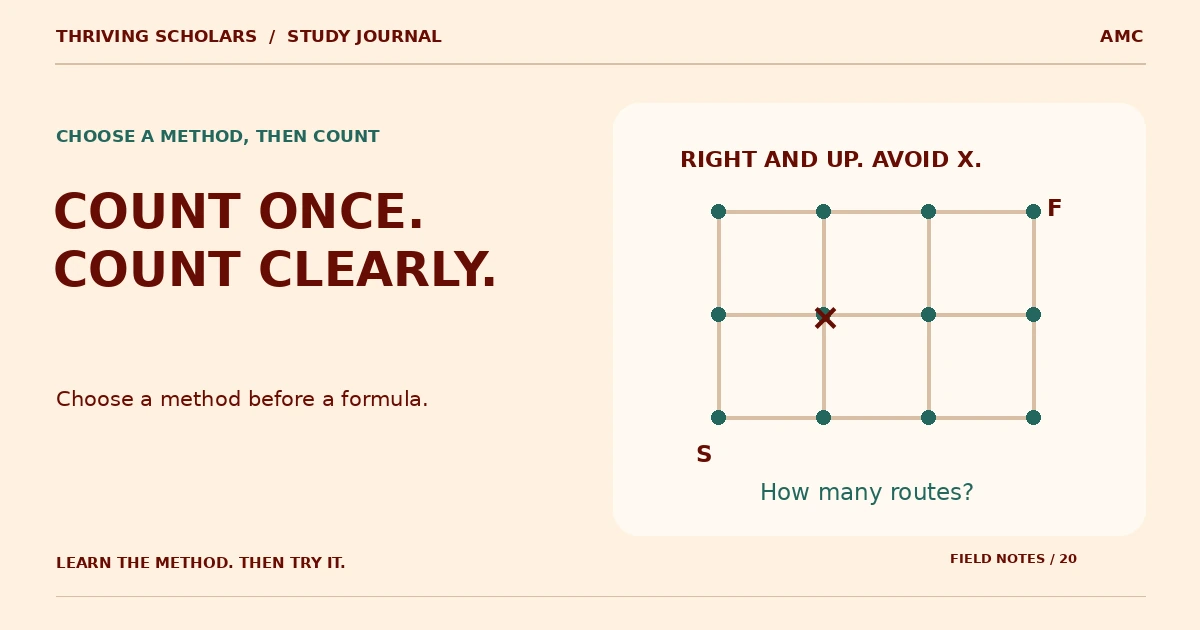
Question 10 uses this grid. The start is S = (0,0), the finish is F = (3,2), and the forbidden vertex is X = (1,1). Each move follows a single edge right or up. A route is forbidden if it visits X, even if it immediately leaves again.
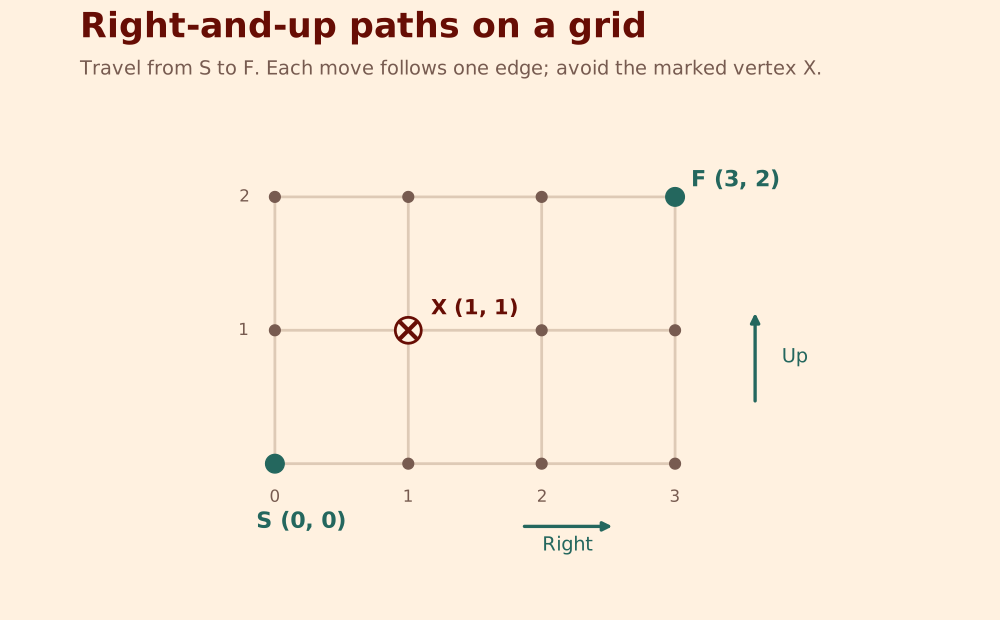
A three-by-two lattice from S at (0,0) to F at (3,2), with the forbidden vertex X at (1,1).
Move only right or up. Passing through vertex X is forbidden; adjacent edges are not themselves forbidden. Work out the count before opening the solution.

The coordinates fully specify the question, so you can redraw the grid before working. The picture represents the exact allowed edges; do not introduce diagonal steps.

Try the twelve original questions

Start untimed. For each question, write the method you chose before calculating. Use a hint only after you can explain where your reasoning stopped. All twelve items are original teaching practice; they are not official past-paper questions or a calibrated mock.

Try it here

Twelve original counting and probability problems

Choose an answer, inspect a hint when useful, and open the complete solution after attempting the problem.

Question 01 · Multiply, then remove restrictionsA café offers 3 bread types and 4 fillings. Every sandwich uses one bread and one filling. Two of the fillings cannot be served with the baguette, but every other combination is available. How many sandwiches can be ordered?
Need a hint?
Count all bread–filling combinations before applying the restriction.
Worked solution

Without restrictions there would be 3 × 4 = 12 combinations. The restriction removes exactly two baguette–filling combinations, leaving 10. Alternatively, the baguette has 2 permitted fillings and each other bread has 4, giving 2 + 4 + 4 = 10.

Why the tempting approach fails: adding 3 + 4 counts ingredients, not complete sandwiches. Multiplying is appropriate because every full choice contains one item from each group. The restriction is applied to combinations, not to all uses of those fillings.

Question 02 · Split by parityA two-digit code uses digits from {1, 2, 3, 4, 5}, with no repeated digit. How many such codes have an even digit sum?
Need a hint?
An even sum comes from two odd digits or two even digits.
Worked solution

There are three odd digits, so codes using two different odd digits number 3 × 2 = 6. There are two even digits, giving 2 × 1 = 2 codes. The cases are disjoint, so add them: 8.

Order matters because 13 and 31 are different codes. Counting unordered digit pairs would give only four selections, and each would then need to be placed in two orders. A mixed odd–even pair has an odd sum and must not be included.

Question 03 · Unordered pairsTwo students are chosen as an unordered pair from six students. A particular pair, students A and B together, is not allowed. How many choices remain?
Need a hint?
Count pairs rather than assigning two different roles.
Worked solution

Choosing a first student and then a second gives 6 × 5 = 30 ordered selections. Every unordered pair appears twice, once in each order, so there are 30/2 = 15 pairs. Remove the single forbidden pair {A, B}: 14 remain.

Do not subtract two after dividing by two. The pair AB and the pair BA have already been identified as the same outcome. If the problem assigned distinct roles instead, the sample space would be different.

Question 04 · Subtract the overlapHow many integers from 1 to 60 inclusive are divisible by 4 or by 6?
Need a hint?
Numbers divisible by both have been counted twice.
Worked solution

There are 60/4 = 15 multiples of 4 and 60/6 = 10 multiples of 6. Their overlap consists of multiples of the least common multiple, 12: there are 5. The answer is 15 + 10 − 5 = 20.

The word “or” includes numbers meeting both conditions. We subtract the overlap once because those numbers appeared twice in the sum and should appear once in the final count. Removing them twice would incorrectly exclude them altogether.

Question 05 · Count the complementA fair coin is tossed three times. What is the probability of getting at least one head?
Need a hint?
There is only one sequence with no heads.
Worked solution

There are 2³ = 8 equally likely head–tail sequences. Exactly one, TTT, contains no head. The event “at least one head” contains every other sequence, so its probability is 1 − 1/8 = 7/8.

Adding the probabilities of a head on toss 1, toss 2 and toss 3 would overcount sequences with more than one head. The complement collects all unwanted outcomes in one simple event.

Question 06 · Count equally likely pairsA bag contains 4 red, 3 blue and 2 green counters. Two counters are selected uniformly as an unordered pair. What is the probability that they have the same colour?
Need a hint?
Count physical counter pairs; colour labels alone are not equally likely.
Worked solution

The total number of physical pairs is 9 × 8 / 2 = 36. Same-colour pairs number 4 × 3 / 2 = 6 red pairs, 3 × 2 / 2 = 3 blue pairs and 2 × 1 / 2 = 1 green pair. Therefore the probability is (6 + 3 + 1)/36 = 5/18.

Red, blue and green are not equally likely selected colours because their counts differ. Treating the three same-colour categories as if they represented equal numbers of outcomes would lose the actual sampling information.

Question 07 · Use a block for adjacencyFour different books A, B, C and D are placed in a row. How many arrangements have A and B not next to one another?
Need a hint?
Count all arrangements, then count those with A and B together.
Worked solution

There are 4 × 3 × 2 × 1 = 24 arrangements in total. When A and B are together, treat them as one block alongside C and D. These three objects can be arranged in 3 × 2 × 1 = 6 ways, and the block can be AB or BA. Thus 12 arrangements have A and B adjacent, leaving 24 − 12 = 12 nonadjacent arrangements.

The block method counts a forbidden condition that is simpler than the allowed condition. Remember the two internal orders; fixing the block as AB would miss half the forbidden arrangements.

Question 08 · Respect the sample spaceAn integer is selected uniformly from 10 through 99 inclusive. What is the probability that it is divisible by 3 but not by 5?
Need a hint?
Count two-digit multiples of 3, then remove those also divisible by 5.
Worked solution

There are 90 equally likely two-digit integers. Multiples of 3 from 12 to 99 number 30. A multiple of 3 that is also divisible by 5 must be a multiple of 15; the two-digit ones are 15, 30, 45, 60, 75 and 90, six numbers. Thus 24 numbers qualify and the probability is 24/90 = 4/15.

Using 99 or 100 as the denominator ignores the lower endpoint. Subtracting every multiple of 5 would also be wrong: only the multiples of 5 already inside the divisible-by-3 set need removal.

Question 09 · Difference of nested setsTwo fair six-sided dice are rolled. What is the probability that the larger of the two results is exactly 4?
Need a hint?
Compare “both at most 4” with “both at most 3”.
Worked solution

There are 36 equally likely ordered dice outcomes. Both values are at most 4 in 4 × 4 = 16 outcomes. Of these, 3 × 3 = 9 have both values at most 3. Removing them leaves 7 outcomes whose maximum is exactly 4, giving 7/36.

You can check by listing (4,1), (4,2), (4,3), (4,4), (1,4), (2,4), (3,4). Adding four outcomes with the first die equal to 4 and four with the second equal to 4 counts (4,4) twice unless you correct it.

Question 10 · Count routes through a forbidden pointOn the grid shown above, a route starts at S = (0,0) and ends at F = (3,2). Each step moves one unit right or one unit up along an edge. How many routes never visit X = (1,1)?
Need a hint?
Subtract routes through X from all routes.
Worked solution

Every route contains three right steps and two up steps. Choose the two positions of the up steps among five: 5 × 4 / 2 = 10 total routes. To reach X, one right and one up step can be ordered in 2 ways. From X to F, two right steps and one up step can be ordered in 3 ways. Hence 2 × 3 = 6 routes pass through X.

The desired count is 10 − 6 = 4. Multiplication is valid because every permitted prefix to X can be joined to every permitted suffix, and monotone routes visit X at most once. The restriction forbids the vertex X itself, not all routes near it.

Question 11 · Split on the final digitA three-digit integer is formed using three distinct digits from {0, 1, 2, 3}. Every such integer is equally likely. What is the probability that it is even?
Need a hint?
The first digit cannot be zero. Separate endings 0 and 2.
Worked solution

There are 3 choices for the first digit, then 3 for the second and 2 for the third, giving 18 integers. An even integer ends in 0 or 2. If it ends in 0, there are 3 × 2 = 6 choices for the first two digits. If it ends in 2, the first digit is 1 or 3, then the middle digit has 2 choices, giving 4.

Thus 10 integers are even and the probability is 10/18 = 5/9. The last digit is not uniformly distributed across the four symbols because the no-leading-zero condition treats zero differently. Simply counting two even symbols out of four misses that constraint.

Question 12 · Organise by remaindersTwo distinct integers are selected uniformly as an unordered pair from {1, 2, 3, 4, 5, 6, 7, 8}. What is the probability that their sum is divisible by 3?
Need a hint?
Group numbers by their remainder after division by 3.
Worked solution

The remainder groups are 0: {3,6}, 1: {1,4,7}, and 2: {2,5,8}. A sum is divisible by 3 when both numbers have remainder 0 or when one has remainder 1 and the other remainder 2.

The first case contributes one pair, {3,6}. The second contributes 3 × 3 = 9 pairs. These cases do not overlap, so there are 10 favourable pairs. The total number of equally likely pairs is 8 × 7 / 2 = 28, giving 10/28 = 5/14.

There is no extra factor of 2 on the 3 × 3 count. Choosing one number from each of two different groups already identifies an unordered pair uniquely. Multiplying by two would count the same pair in reverse.

A result out of twelve describes this practice set only. Review the method behind each error; it does not predict an official AMC score.

How to turn the solutions into a skill

After checking an answer, identify the decisive sentence. In question 7, it is the decision to count adjacent books as a block. In question 11, it is the decision to split according to the units digit because zero behaves differently. Remembering only “12” or “5/9” misses the part that transfers to a new question.

Next, change one condition and predict which part of the argument must change. For question 3, assigning two different roles would make order matter. For question 6, drawing with replacement would change the probability model. For question 10, allowing leftward steps would destroy the fixed five-step description unless another restriction were supplied.

Finally, verify a small case by direct enumeration. A trustworthy counting argument and a complete small list should agree. When they do not, look for a duplicated outcome, an impossible case or a missing boundary condition before reaching for another formula.

Mix these questions with other topics during later practice so the method is no longer announced by the lesson title. The ten-week AMC 8 preparation plan shows how to place counting practice between topic work, mixed sets and full rehearsals. For further level-specific exercises, explore the AMC 8 question bank.

Before you go

Common questions

When should I add and when should I multiply?
Multiply when a complete outcome is built through successive choices, using the correct number available at each stage. Add counts for different cases, provided the cases do not overlap or you explicitly correct the overlap.
When do I divide by two?
Only when your original count includes every wanted object exactly twice. Ordered selections of two distinct objects become unordered pairs after dividing by two. Do not divide merely because the problem mentions two objects.
Why is the probability in question 11 not one half?
The no-leading-zero condition makes final digits occur in different numbers of valid integers. There are ten even integers out of eighteen valid three-digit integers, giving 5/9.
Are these official AMC 8 past-paper questions?
No. They are original teaching questions with complete explanations. They practise relevant counting and probability ideas without reproducing an official paper.
Do I need advanced formulas for AMC 8 counting?
These twelve questions can be solved with systematic lists, multiplication, casework and complements. Understanding why a count is complete is more useful than applying a formula whose assumptions you have not checked.

Sources & further reading

Official rules and programme details can change. Use the linked source for your exact course, competition or examination session.

  1. MAA AMC competition overviewConfirms counting and probability are part of AMC 8 content. All problems, solutions and teaching advice here are original.