
Start by separating knowledge from execution

If your AMC 10 scores sit around 75–95, it is tempting to look for a harder book or another complete paper. Sometimes you need more mathematical knowledge. Sometimes you already know enough to solve a missed problem, but choose an unnecessarily long method, drop a case or answer the wrong quantity.

The score range in this title describes a reader who may find the exercises useful; it is not a diagnostic category. The seven mistakes below are teaching priorities selected for this article, not a statistical claim about the most common errors in a student database.

Take your last marked paper and choose three questions you believe you should have solved. Before reading the solutions again, finish them without a time limit. If you can now solve them, investigate timing, recognition or execution. If you remain stuck, identify the first fact or idea you need to learn. Both outcomes tell you what to do next.

Seven mistakes, seven worked repairs

All questions and follow-ups in this lesson are original practice. Several are deliberately accessible: a repair drill isolates one decision so you can make it reliable before combining it with more difficult ideas. The final item is a scoring decision exercise rather than a conventional contest problem.

Attempt each question first. Then read the solution, explain the repair habit in your own words and try the follow-up before opening its answer.

Try it here

Seven original repair problems

Each solution includes a separate solved follow-up. These drills teach habits; they are not a calibrated AMC 10 mock.

Question 01 · Algebraic structure1. Expanding before looking for structure. Real numbers x and y satisfy x + y = 11 and xy = 24. Find x² + y².
Need a hint?
Square the sum and identify the term you do not want.
Worked solution

The identity (x + y)² = x² + 2xy + y² gives x² + y² = 11² − 2 × 24 = 73. Finding x and y separately is possible, but introduces a quadratic and extra calculation that the requested expression does not require.

Repair habit: before solving for individual variables, ask whether the target expression can be built directly from what you know. This is a choice of method, not an instruction to avoid algebra.

Follow-up: u + v = 13 and uv = 30. Find u² + v².

The same identity gives 13² − 2 × 30 = 169 − 60 = 109. The useful clue is that the sum and product are known while the target contains squares.

Question 02 · Roots and signs2. Losing a valid case. The real solutions of x² = 5x + 14 are r and s. What is |r| + |s|?
Need a hint?
Move everything to one side and factor. Both roots are relevant.
Worked solution

Rearranging gives x² − 5x − 14 = (x − 7)(x + 2) = 0. The roots are 7 and −2. Therefore |r| + |s| = 7 + 2 = 9. The fact that the final answer is positive does not imply that both roots are positive.

Repair habit: write the allowed domain next to the variable. After factoring, keep every root that satisfies the original equation, then apply the operation actually requested.

Follow-up: the roots of y² = 2y + 24 are p and q. Find |p| + |q|.

y² − 2y − 24 = (y − 6)(y + 4), so the roots are 6 and −4. Their absolute values add to 10. Both roots satisfy the original equation.

Question 03 · Ordered counting3. Treating different roles as an unordered group. Seven students are available for two different roles: presenter and timekeeper. No student can fill both roles. Students A and B may not both be selected. How many assignments are possible?
Need a hint?
Count all assignments, then remove the forbidden assignments.
Worked solution

There are 7 choices for presenter and 6 for timekeeper, giving 42 ordered assignments. Exactly two assignments select both A and B: A presenting with B timing, or B presenting with A timing. The answer is 42 − 2 = 40.

Choosing an unordered pair gives only 21 groups before the restriction. Each allowed group can fill the roles in two ways. The distinction is in the problem’s meaning: swapping the roles changes the assignment.

Follow-up: repeat the problem with eight students, keeping the same restriction on A and B.

There are 8 × 7 = 56 role assignments. Remove the same two forbidden assignments to obtain 54.

Question 04 · Reading the target4. Answering an intermediate question. A rectangle has perimeter 34 cm. Its length is 3 cm more than its width. What is its area?
Need a hint?
Use the perimeter to find the dimensions, then return to the quantity asked for.
Worked solution

If the width is w, the length is w + 3. The perimeter equation is 2w + 2(w + 3) = 34, so 4w = 28 and w = 7. The length is 10. The requested area is 7 × 10 = 70 cm², not either dimension or the perimeter.

Repair habit: write a small target label, such as “area”, before calculating. At the end, check both the quantity and its units.

Follow-up: a rectangle has perimeter 46 cm and length 5 cm greater than width. Find the area.

4w + 10 = 46 gives w = 9 and length 14. The area is 126 cm². Checking 2(9 + 14) = 46 confirms the dimensions.

Question 05 · Rates and fractions5. Confusing the whole job with the remaining job. A device sends 3/5 of a file in 18 seconds at a constant rate. How many more seconds are needed to send the rest?
Need a hint?
First find the time for one fifth, or for the whole file.
Worked solution

Three fifths take 18 seconds, so one fifth takes 6 seconds. Two fifths remain and require 12 seconds. Alternatively, the whole file takes 18 ÷ (3/5) = 30 seconds, and 30 − 18 = 12.

The value 30 answers a different question: the total time from the beginning. Checking the word “more” prevents an otherwise sound calculation from leading to the wrong option.

Follow-up: a printer completes 5/8 of a job in 25 minutes at a constant rate. How much longer does it need?

One eighth takes 5 minutes. The remaining three eighths take 15 minutes. The full job takes 40 minutes, which gives the same result after subtracting 25.

Question 06 · Remainder cycles6. Repeating a long calculation without seeking a pattern. What is the units digit of 72026?
Need a hint?
Write the units digits of the first few powers, then identify the repeat length.
Worked solution

The units digits of successive powers of 7 are 7, 9, 3, 1, then 7 again. This four-step cycle repeats because multiplying a number by 7 determines the next units digit from the current one. Since 2026 = 4 × 506 + 2, the required digit is the second in the cycle: 9.

Repair habit: when an exponent or number of cases is large, test a few small cases and look for a structure that you can justify. A pattern is useful only after you know why it continues.

Follow-up: what is the units digit of 32027?

The cycle is 3, 9, 7, 1. Since 2027 has remainder 3 on division by 4, the units digit is 7.

Question 07 · Expected score7. Treating every guess as the same decision. In an AMC 10 decision exercise, you have correctly eliminated two of the five answer choices. The remaining three are equally likely to be correct, and you will choose one uniformly at random. How much higher is the expected score than leaving the question blank?
Need a hint?
Compare 6 times your success probability with the 1.5 points for a blank.
Worked solution

The expected score from guessing is 6 × (1/3) = 2. A blank earns 1.5, so the expected gain is 0.5 points. This is an average over repeated comparable decisions, not a fractional score you will receive on this question: the actual outcome is 6 or 0.

The assumption that the remaining choices are equally plausible is essential. If an elimination is incorrect, the calculation no longer describes the situation.

Follow-up: what is the expected-score difference if four equally likely choices remain?

A random choice gives expectation 6/4 = 1.5, equal to the blank score. The difference is 0. The expected scores match but the risk does not: the guess still produces either 6 or 0.

Use missed questions to select a repair task. A result out of seven does not convert into an AMC score.

Use a progress-based move-on rule

A timer cannot decide whether a problem deserves more attention; your progress matters. If you have a clear chain of steps and only need to finish a calculation, continue. If you have spent time rewriting the same equation without reducing the uncertainty, mark the question and move on.

In practice, keep a short note beside a slow problem: “tried factorisation; no integer factors” or “direct counting overlaps”. That note makes a later return more effective. You can try a different representation instead of restarting the same unsuccessful approach.

Do not use question position as a perfect measure of difficulty. A later question may match a method you recognise, while an earlier one may expose a personal gap. Use your own evidence: what do I know, what remains unknown, and do I have a useful next step?

Keep the scoring rule separate from intuition

AMC 10 awards 6 points for a correct answer, 1.5 for a blank and zero for an incorrect answer. If your chosen option has probability p of being correct, guessing beats a blank in expected score when 6p > 1.5, or p > 0.25. Official scoring source.

Do not turn that into “always guess after eliminating an option”. Four equally likely choices produce the same expected score as a blank. Three equally likely choices give a larger expected score, provided your eliminations are valid.

Aiming to maximise expected score also differs from maximising the chance of passing one fixed threshold. The AIME cutoff and score-calculator guide demonstrates both objectives with exact numerical examples. During a real paper, avoid assuming that every answer you felt confident about is certainly correct.

A seven-day repair cycle

DayTaskEvidence to keep
1Review a previous paper and choose two recurring issues.Three concrete examples, including the first wrong step.
2Study one issue using a worked example and fresh follow-up.A short explanation of the recognition clue.
3Study the second issue; keep the workload manageable.A complete solution without relying on hints.
4Mix both issues with unrelated questions.Whether you choose the right method without a topic label.
5Revisit earlier errors after a gap.A fresh attempt, not copied working.
6Attempt a suitable timed set or full mock.Where time produced progress and where it did not.
7Review, then choose the next repair cycle.Which errors disappeared and which still recur.

This is a suggested routine. If a conceptual gap is substantial, spend another cycle teaching it instead of forcing a full paper into the calendar. The goal is to make the next attempt more informative and your mathematical decisions more dependable.
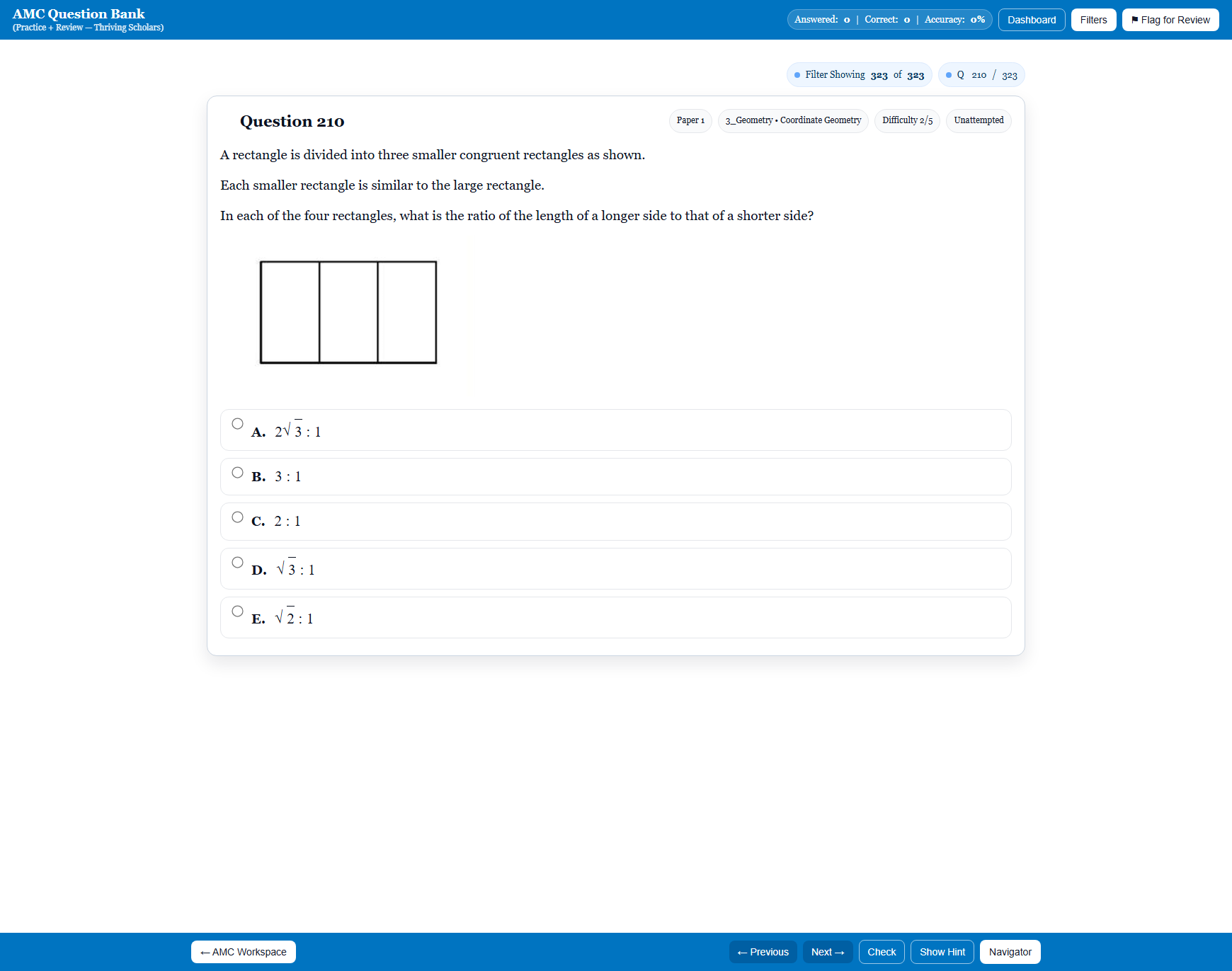
Thriving Scholars AMC question-bank demonstration with a geometry question and review controls.
Public Thriving Scholars AMC portal screenshot. Use the linked programme page to check current access and coverage. View the programme →

Measure the improvement you are actually practising

Keep three measures alongside the total: the number of accessible questions answered accurately, the number of errors repeated from the previous review, and the number of questions you can now explain without a hint. These measures reveal whether a repair is taking hold even when a new paper is harder.

Correct guesses deserve review too. Ask whether you could justify the answer and whether the elimination was sound. A lucky choice should not silently become evidence that a topic is secure.

For your next session, choose one mistake from this lesson and solve three fresh problems that use the same idea in different settings. The AMC portal can support that focused practice. Return to a full mock once you have something specific to test.

Before you go

Common questions

Does a score of 75–95 mean I lack the mathematics for AMC 10?
The total alone cannot answer that. Finish missed questions untimed, then separate missing concepts from method selection, reading and calculation errors. Different causes require different practice.
Should I focus only on the first fifteen questions?
Reliable work on accessible questions is valuable, but question order is not a perfect difficulty ranking. Practise selecting problems by whether you recognise a productive approach, and revisit marked questions.
How long should I spend on a question?
Use progress as well as elapsed time. Continue when you have a clear route; move on temporarily when you are repeating an approach without learning anything new. Test that habit in mocks.
Should I practise with a calculator?
AMC competitions prohibit calculators. Build the required arithmetic and estimation into practice; checking a solution afterwards is different from using a calculator during a timed rehearsal.
Will these seven repairs guarantee AIME qualification?
No. They isolate useful skills and decisions. Qualification depends on your official contest result and eligibility; a short practice set cannot predict it.

Sources & further reading

Official rules and programme details can change. Use the linked source for your exact course, competition or examination session.

  1. MAA current AMC rules and policiesScoring and calculator restrictions; the mathematical examples and study routine are original.