Five minutes can be useful—or disappear without progress
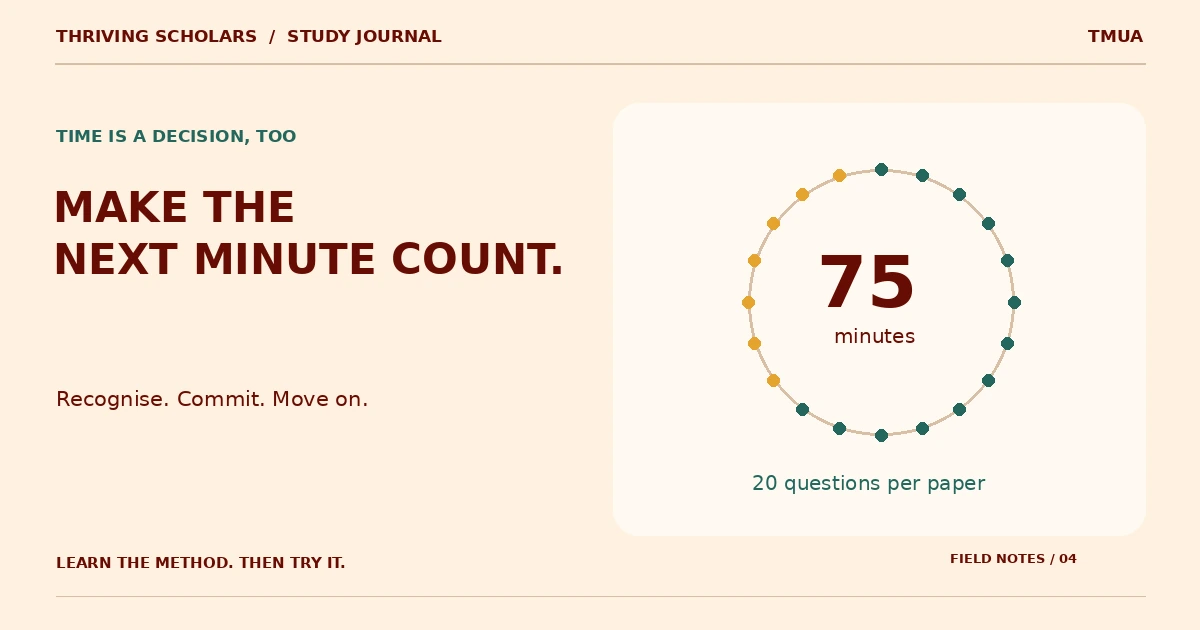
TMUA gives 75 minutes for 20 questions in each paper. The average is 3 minutes 45 seconds per question, but questions do not all require the same time. An average is a planning reference, not a command to spend that long on each item. See the official format.
The more useful question is “What information did the last minute produce?” A minute that establishes a valid substitution may be worthwhile. A minute spent repeating the same failed expansion is a signal to change approach or leave the question temporarily.
You do not need a dramatic new speed technique. You need a way to notice unproductive work early, preserve useful thinking and return to the question with a clearer starting point.
Find out which kind of slow you are
| What you observe | Likely next task |
|---|---|
| Still stuck when untimed | Rebuild the concept or representation. |
| Correct untimed; arithmetic deteriorates under time | Short timed sets and a compact checking routine. |
| One difficult item consumes a large share of the paper | Practise the decision to flag and return. |
| Restarting flagged work takes several minutes | Leave clearer notes and organised working. |
| Familiar reattempts are fast; fresh questions are slow | Use unseen mixed practice to check transfer. |
These are starting hypotheses, not diagnoses from a validated test. Compare several attempts before deciding that one bad session reveals a permanent weakness.
Rehearse the decision before test day
A shorter route must still be justified
Example 1: work with the difference
Find x for which (x+2)/(x−1) ≥ (x+1)/(x−2). First exclude 1 and 2. Subtract the right side: the numerator becomes (x²−4)−(x²−1)=−3. So −3/[(x−1)(x−2)] ≥ 0 requires a negative denominator. The answer is 1<x<2.
Why it saves time: it reduces the task to a sign decision. Multiplying by both denominators without checking their signs can produce a fast but invalid solution.
Example 2: identify the target
If x+y=7 and x²+y²=29, find xy. Squaring the sum gives 49=29+2xy, hence xy=10. Solving separately for x and y would work, but it answers a larger question than the one asked.
Transfer: before expanding or solving, ask whether the requested expression appears in a useful identity.
Make the return easier than the first attempt
When you leave a question, preserve the step that matters. “Quadratic in t, t>0” is more useful than “hard”. “Need one counterexample” is more useful than a half-page of unrelated trials. Write the question number clearly and keep separate attempts apart.
On returning, read the original question again before trusting the abandoned working. You may have been solving for the wrong quantity. Check any assumption that caused the earlier route to stall. If there is still no productive route, make the best available answer decision and use the remaining time where it can help.
Use the official practice player to become familiar with navigation and review controls. Interface familiarity complements mathematical practice. It should not require experimenting with unfamiliar controls during the live test.
Audit one paper without turning it into a spreadsheet project
Choose the three items that absorbed the most time. For each, record the first useful observation, the unproductive detour and a better restart note. Then choose one repair for the next practice session.
If the issue was calculation, use a few fresh examples of that calculation in context. If it was recognising structure, compare related problems with different surface wording. If it was reluctance to skip, rehearse a small mixed set in which you deliberately make and review flagging decisions.
Study suggestion: explain one slow solution aloud to another student. Ask them to interrupt at the first step whose purpose is unclear. The explanation often reveals the unnecessary detour.
Connect timing to your next topic
The TMUA Practice Test Series provides timed work to review, while the Question Bank provides the focused practice that follows. Keep the loop small: attempt, identify one cause, repair it, then test again on new material.
If you want a quick starting point, try the public mini-test. Its short result is a useful practice record, not an official or validated predicted score.
Common questions
Should I spend exactly 3 minutes 45 seconds on each question?
How long should I wait before skipping?
Should I guess unanswered questions?
Is doing more full mocks the best way to improve speed?
Should I review correct answers?
Sources & further reading
Official rules and programme details can change. Use the linked source for your exact course, competition or examination session.
- Official TMUA formatTiming, question count and no penalty for wrong answers.
- Official practice player guidanceInterface familiarisation and free preparation.