The answer before the anxiety
There is no universal TMUA score that guarantees an offer. A useful interpretation depends on the admissions cycle, the course and how that university uses the test alongside the rest of your application. The official result is one overall score from 1.0 to 9.0, reported to one decimal place. UAT-UK explains the scoring and how universities receive results.
Start with the official result in your account. Then ask three questions: which cycle does it belong to, what comparison does the official results explanation support, and what does my course actually publish? This order prevents an old forum target or an impressive mock percentage from becoming an unreliable admissions rule.
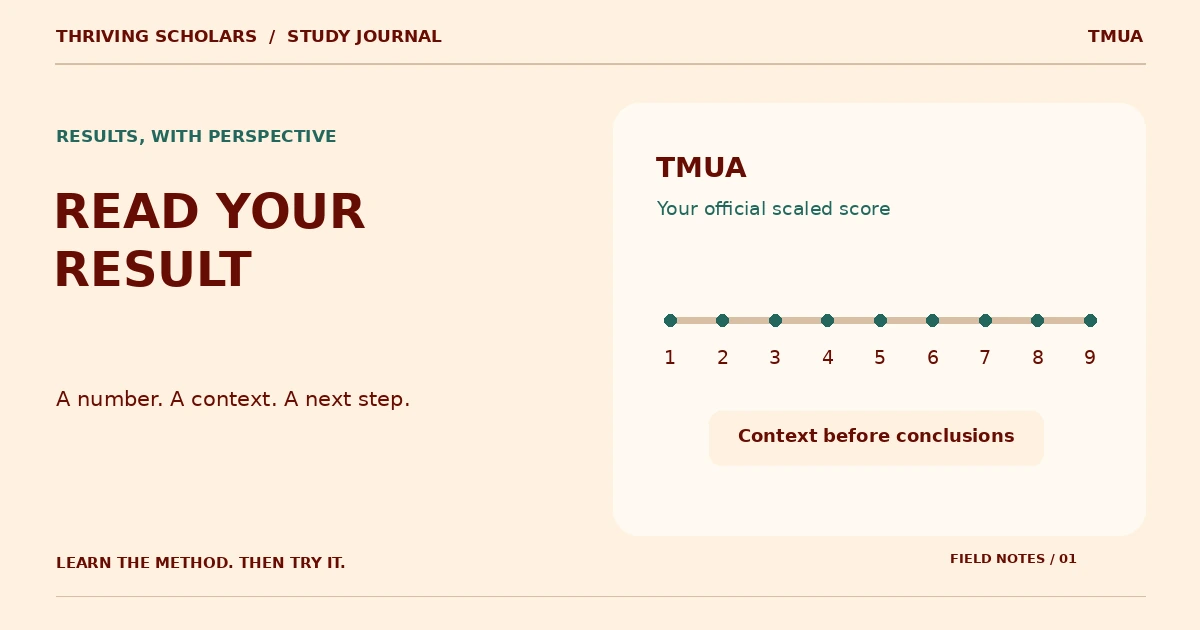
Place your official score on the scale
Enter a score you have actually received. The explorer shows its position on the published scale and reminds you which evidence to check next. It does not convert a mock mark, invent a percentile or estimate an offer probability.
The difference between 4.5 and 5.5 is one point on the reported scale. It does not mean an extra ten percentage points of questions, and it does not imply a fixed change in admission probability. The scale is not a percentage mark.
What 4.5, 6.5 and 7.0 can tell you
The official explanation for the October 2025 and January 2026 sittings described typical candidates as scoring around 4.5 and approximately 10% scoring higher than 7.0. Those are labelled historical reference points. They do not provide a fresh percentile for an October 2026 result. Read that dated explanation.
A 6.5 may be strong evidence in one application context, but the number alone cannot tell you whether it meets an unpublished course threshold. A 7.0 should not be described as an admission guarantee. A 4.5 is not equivalent to failing: there is no official pass/fail boundary.
When someone posts a score online, check its year before comparing it with yours. Also check whether they mean an official result, a past-paper conversion or a commercial mock estimate. Each answers a different question. Preserve the original label when you record your own practice.
Read the course, not just the university name
These examples show how different official statements should be read. They are a guide to the evidence, not a list of promised offers. Search the table for your institution and follow the course source for the complete conditions.
For a programme not shown, open its own admissions page. Record whether TMUA is required, how results are used, the entry year and any explicitly published conditions. If a page gives past offer-holder data, retain the year and the population: applicants, offer holders and enrolled students are not interchangeable groups.
Why 28/40 on a mock is a different kind of evidence
A raw result tells you how many questions you answered correctly on a particular paper. It is useful for reviewing your work. It cannot, by itself, establish a reliable current official scaled score. Difficulty, the paper, the conditions and whether you have seen any questions before all matter.
For example, a first timed attempt with 24 correct answers and three unfinished questions suggests a different next task from an untimed reattempt with 34 correct answers. Keep both records, but annotate them honestly. UAT-UK deliberately does not award scaled scores for its sample tests and warns that practice performance need not indicate live-test performance. Read the official preparation guidance.
A useful practice record
Record paper name, date, first attempt or reattempt, conditions, raw correct answers, unanswered questions and the two most useful lessons. Add the next practice task in one sentence. This turns a mark into evidence you can act on.
Choose the next action that fits your situation
For results-day readers, the priority is understanding the application already in progress. For students who have not yet sat the test, the priority is building a repeatable preparation routine. The distinction matters: January is not a second attempt after October in the same admissions cycle.
Keep an application note containing the official result, course sources and any dates relevant to an interview or requested information. Avoid repeatedly revisiting unsourced admissions predictions; it rarely produces a new decision. If a university asks for action, use its stated process and deadline.
How Thriving Scholars can help before your sitting
If you are still preparing, use the public TMUA mini-test to experience a short digital practice session, then use the result to choose a focused topic. The Question Bank supports targeted practice, while the Practice Test Series supports timed attempts and review.
Our study suggestion is to make every completed test produce one concrete change: a topic to rebuild, a method to shorten or a decision to rehearse. The purpose of practice is to improve the next attempt, not to give every attempt an impressive-looking predicted number.
Common questions
Is 5.0 a good TMUA score?
Does 7.0 guarantee an offer?
Can I retake in January after sitting in October?
Can I convert a raw practice mark into an official score?
Where can I find October 2026 percentiles?
Sources & further reading
Official rules and programme details can change. Use the linked source for your exact course, competition or examination session.
- UAT-UK resultsScale, single result, interpretation and absence of a pass mark.
- UAT-UK deadlines2026–27 dates and one sitting per cycle.
- Imperial score guidanceHolistic use of test results.
- LSE TMUA guidanceCourse requirements for 2027 entry.
- Warwick Mathematics offerCurrent 2027 offer conditions.
- UAT-UK preparationOfficial free practice and limitations of sample-test results.